AI Code Review Tools in 2026: The PR Surface Is the Product
The code review bot is no longer the product. The product is the full pull request surface: the comment, the fix, the diagram, the team rule, the dashboard, the documentation trail, and the evidence that the signal is real.
The short version: CodeRabbit has the broadest PR-native surface today; CodeAnt has the most meaningfully structured inline PR comments; GitHub Copilot Code Review is the easiest default for GitHub-native teams; Qodo is strongest when you want commandable review, ticket, test, and docs agents; Graphite is strongest when review workflow and metrics are the real problem; Cursor Bugbot is strongest for teams already living in Cursor and wanting a tight bug-to-fix loop.
Greptile and SonarQube deserve a watchlist slot. Greptile is moving quickly on codebase-aware review and rule configuration. SonarQube remains a serious quality-gate control plane, especially for static analysis and compliance, but it is a different category from conversational AI PR review.
Why This Category Matters Now
AI coding changed the economics of pull requests. The marginal cost of generating code has fallen, but the cost of trusting code has not. That shifts the bottleneck from writing to reviewing: understanding intent, checking edge cases, verifying requirements, preserving architecture, and deciding whether a change is safe to merge.
Independent code review research is useful here because it keeps the story grounded. Google's modern code review case study frames review as a mechanism for quality, maintainability, knowledge sharing, and team coordination. McIntosh and colleagues connect review coverage and reviewer participation to software quality outcomes. Newer work on GitHub review suggestions shows that actionable suggestions can affect merge behavior and create reusable knowledge for future contributors.
That is why the best AI review products are no longer "a bot that leaves comments." They are systems for moving review knowledge into the workflow: instructions, learned rules, analytics, fix loops, and evidence. A tool that finds one real bug but trains nobody and leaves no measurable trail is less valuable than a tool that helps the team become consistently better at reviewing.
 aictrl-dev
inline-code-review skill. 3 inline comment(s).
This is the PR surface buyers should inspect: diff context, bot identity, line-local finding, code spans, threaded replies, and links back to the review workflow. Richer tools add summaries, collapsible traces, suggested changes, diagrams, task lists, and links to tickets or docs.
What the Research Actually Supports
The strongest peer-reviewed evidence is still about human code review, not AI code review. Bacchelli and Bird's ICSE study at Microsoft found that defect finding is the headline motivation, but modern review also delivers knowledge transfer, team awareness, alternative solutions, and code understanding. McIntosh, Kamei, Adams, and Hassan then connected review coverage, participation, and reviewer expertise with post-release defects across Qt, VTK, and ITK. Google's ICSE case study adds industrial scale: interviews, a developer survey, and 9 million reviewed changes.
That evidence is relevant to DORA metrics, but it is not a direct causal proof that "more review improves DORA." Code review sits upstream of DORA outcomes. Better review can plausibly reduce change failure rate by catching defects before merge. It can reduce lead time for changes if comments are actionable and review queues move faster. It can improve MTTR when hotfixes are reviewed with better context. It can also hurt lead time if tooling creates noisy comments, longer debates, or extra revision cycles.
This is why AI code review should be evaluated as a delivery-system intervention, not as a comment generator. The right research question is not "did the bot find bugs?" It is: did adoption change escaped defects, review turnaround time, time to first useful comment, time to resolution, change lead time, change failure rate, and rework?
| Publication | Numbers worth using | What this means for AI review |
|---|---|---|
| Bacchelli & Bird, ICSE 2013 | Microsoft field study of tool-based review using observation, interviews, surveys, and manual classification of hundreds of comments. | Review is not only defect detection. It also produces knowledge transfer, team awareness, alternative solutions, and code understanding. |
| McIntosh et al., EMSE 2016 | Case study of Qt, VTK, and ITK. The earlier ICSE version estimated low review coverage and low participation at up to 2 and 5 additional post-release defects, respectively. | Review coverage, participation, and expertise are credible quality levers. AI review should be measured against escaped defects, not comment volume. |
| Sadowski et al., Google ICSE 2018 | 12 interviews, 44 survey respondents, and logs from 9 million reviewed changes. | At scale, review is a socio-technical system. AI tools need to support reviewer intent, not just static issue detection. |
| Fregnan et al., EMSE 2022 | 1,510 classified review changes across 3 open-source projects. Around 90% of classified changes concerned evolvability or maintainability. Undocumented review changes were 64.6% in Android, 60.7% in JGit, and 80.7% in Java-client. | Good review often improves maintainability, structure, and documentation rather than finding dramatic functional bugs. AI review scoring should not ignore maintainability outcomes. |
| Bouraffa et al., CHASE 2025 | 46 GitHub projects; 2,852 PRs used suggestions and 8,672 suggestions were mined. For the closed-PR merge-rate analysis, 2,548 PRs with suggestions merged at 76.2%, compared with 65.7% among 24,150 PRs without suggestions after feature introduction. Resolution time increased. Suggestion categories: improvements 48.51%, documentation 26.37%, code style 17.13%, fixes 8.00%. | Actionable suggestions can improve merge likelihood and knowledge transfer, but they can slow resolution. "More comments" is not automatically better turnaround time. |
| Sun et al., IEEE TSE 2026 / arXiv 2025 | 16 AI review GitHub Actions; 178 mature repositories; 3,002 PRs; 22,326 AI-generated comments. In the deeper addressing analysis, valid human comments led to code changes 60% of the time, while valid AI comments ranged from 0.9% to 19.2% depending on tool. Manual triggering improved addressing from 9.0% to 14.4% overall. | AI review impact is real but uneven. Hunk-level, concise, code-rich, manually triggered comments are more likely to matter. This supports CodeAnt-style structured inline feedback and CodeRabbit-style hunk-level review, but not blanket automation. |
| Oliveira et al., arXiv 2026 | Two GitHub classroom cohorts with more than 100 students. The later cohort produced 1,176 PRs vs 581; failed AI review attempts dropped from 227 to 0 after tooling/instruction refinements; 32%-33% of successfully AI-reviewed PRs were followed by subsequent commits. | AI review can scaffold learning and iteration, but this is educational evidence. It should not be generalized directly to enterprise defect rate or MTTR. |
| SWE-PRBench, 2026 | 350 pull requests with human-annotated ground truth. The paper reports frontier models detecting 15%-31% of human-flagged issues in a diff-only setup. | Benchmarks are useful for capability baselines, but production value still depends on context, severity, false positives, and whether teams act on findings. |
Research agenda for AI code review
The field needs controlled longitudinal studies that compare pre/post adoption and matched control teams on escaped defect rate, change failure rate, mean time to recovery, PR turnaround time, time to first review, time to resolution, rework rate, and reviewer load. The strongest current evidence says review quality matters and AI comments can lead to code changes, but it does not yet prove broad DORA improvement from AI reviewer adoption.
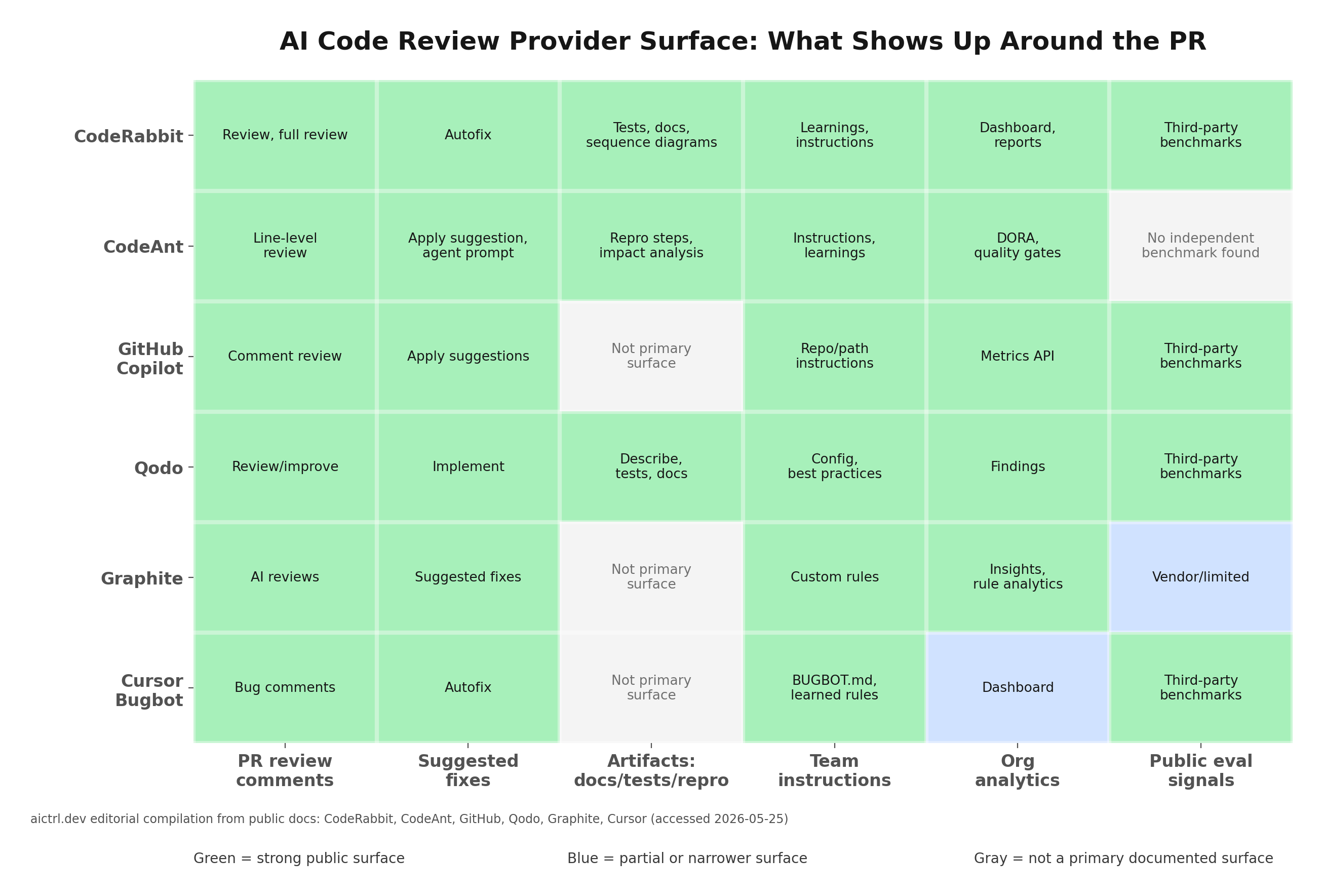
The Core Providers
1. CodeRabbit: the broadest PR-native surface
CodeRabbit is the clearest example of where the market is heading. Its public docs cover the familiar surfaces - automated and manual reviews, PR summaries, inline comments, review controls - but the more interesting pieces are around the edges. The command surface includes docstring generation, unit test generation, Autofix, and a sequence diagram command for complex PRs. Its Learnings system lets teams capture natural-language preferences from review conversations and reapply them at repository or organization scope. The dashboard and reporting docs go further by defining metrics around review activity, estimated review effort, knowledge-base usage, pre-merge checks, reports, and data export.
The practical value is not just "it comments on PRs." It is that CodeRabbit tries to make the PR self-explaining: what changed, why it may matter, what can be fixed, what tests or docs should exist, and what the team has taught the reviewer over time. For teams asking for diagrams, repro guidance, and richer review context, CodeRabbit currently shows the broadest public surface.
2. CodeAnt: the strongest inline-comment shape
CodeAnt deserves to be in the core set because its documented inline comment format maps directly to what developers need when a reviewer flags a bug. Each comment is designed around an issue description, severity, suggested fix, and steps of reproduction. The reproduction step is the standout: CodeAnt documents numbered execution paths with file paths and line numbers so a developer can verify the issue, understand the root cause, test a fix, and explain the finding to teammates.
That makes CodeAnt's PR comments more meaningful than a generic "this might be wrong" AI observation. The docs also describe impact analysis for high-severity findings, direct replies for clarification or disagreement, learnings to reduce future false positives, quality-gate integration, DORA metrics, sprint reports, and a Claude Code flow for resolving unresolved CodeAnt comments from the terminal. Its independent benchmark footprint is lighter than CodeRabbit, Copilot, Qodo, Cursor, and Greptile in the Signal65 study, but the product surface for inline PR comments is unusually concrete.
3. GitHub Copilot Code Review: the default inside GitHub
GitHub's advantage is distribution. Copilot Code Review lives inside the platform where many teams already request reviews, resolve conversations, apply suggestions, and merge. The docs are explicit about its authority: Copilot leaves comment reviews and does not count as an approval or request changes. That is a sensible boundary for enterprise use. It can suggest changes, be manually requested, be configured for automatic reviews, and use repository or path-specific custom instructions.
The analytics story is stronger than many people realize. GitHub's Copilot usage metrics now include pull request activity fields such as review suggestions, applied suggestions, Copilot-created PRs, Copilot-reviewed merged PRs, and median minutes to merge for Copilot-reviewed PRs. For organizations already using GitHub Enterprise, that makes Copilot the easiest tool to connect to adoption reporting. The tradeoff is that the visible review surface is less specialized than CodeRabbit or Qodo, and custom instruction limits require discipline.
4. Qodo: commandable review agents for PR, ticket, tests, and docs
Qodo, formerly Qodo Merge in its v1 docs, exposes a very explicit agent command model. The documented workflow includes /describe for PR title, summary, walkthrough, and labels; /review for feedback, security concerns, and review effort; /improve for actionable code improvements; /ask for PR questions; and implement, documentation, test, component analysis, and code search tools. The review tool can check tests, review effort, whether a PR should be split, security, and whether a linked GitHub or Jira ticket was fulfilled.
Qodo's cross-organization Findings page is the important analytics surface. It tracks total critical findings, the percentage resolved before merge, average critical findings per PR, repository, state, action level, category, and export. That matters because a review bot becomes operationally useful when managers can see which risks are being fixed and which are bypassed.
5. Graphite: review workflow, stacked PRs, and rule analytics
Graphite is not just an AI reviewer. It is a code review workflow product: PR inbox, stacked PRs, merge queue, review UI, notifications, and engineering velocity metrics. Its AI review docs emphasize custom rules that encode team standards, architectural guidelines, security expectations, and performance checks. The strongest differentiator is analytics on those rules: issues found, PRs reviewed, accepted issues, acceptance rate, and upvote/downvote rates.
Cursor announced in December 2025 that Graphite would join Cursor, while continuing to operate independently with the same team and product. That makes Graphite strategically interesting: it sits at the boundary between local AI coding and collaborative review. If your review problem is queueing, stack management, reviewer load, and rule acceptance, Graphite may be a better fit than a narrower bot.
6. Cursor Bugbot: the bug-to-fix loop for Cursor teams
Cursor Bugbot is designed around a narrower promise: find meaningful bugs, edge cases, and security issues in PRs, then route the fix into Cursor. The public Bugbot announcement describes automatic PR review, BUGBOT.md rules for custom knowledge, dashboard statistics, and one-click handoff to Cursor or a background web agent. The February 2026 Autofix announcement extends that loop: Bugbot can propose fixes through cloud agents running in virtual machines to test software.
Bugbot is strongest when your developers already use Cursor and want the PR finding to become an executable fix task quickly. The caution is the same as for every agentic fix loop: merged Autofix rates and resolution rates are useful product telemetry, but they are not a substitute for a transparent benchmark or a human-controlled quality gate.
Watchlist: Greptile and SonarQube
Greptile is worth watching because it emphasizes codebase indexing, cross-repository context, custom instructions, strictness controls, PR summaries, inline comments, and suggested fixes. SonarQube belongs beside AI reviewers in many enterprise stacks because pull request decoration, quality gates, and AI CodeFix solve a different but adjacent problem: deterministic quality control for new code.
What Features Actually Matter on the PR?
The best PR surface reduces reviewer cognitive load. It should help a reviewer answer five questions fast: What changed? What might break? How would I reproduce or verify the suspected bug? What fix is proposed? What team rule or product requirement is involved?
The rendering layer matters because it determines whether the finding becomes usable. A review product that can format a concise summary, a collapsible reproduction trace, a one-click code suggestion, a Mermaid sequence diagram, and links to the relevant ticket or product requirement is solving a different problem than a bot that posts a paragraph of generic advice.
"Instructions to reproduce a bug" is still not a universally explicit product feature. CodeAnt is the clearest public example of treating reproduction as part of the inline comment itself. Many other tools offer explanations, suggested fixes, test generation, or Autofix, but they do not always produce a minimal repro as a first-class artifact. Buyers should ask for that directly in pilots: when the tool flags a logic bug, can it provide a minimal input, failing path, expected behavior, actual behavior, and verification test?
| Surface | Why it matters | Where it appears today |
|---|---|---|
| Walkthrough and summary | Compresses review orientation before a human reads every diff. | CodeRabbit walkthroughs, CodeAnt summaries, Qodo /describe, Greptile summaries, GitHub PR summaries. |
| Inline findings with reasoning | Turns vague warnings into localized review work. | All six core providers, with CodeAnt standing out for structured reproduction and impact detail. |
| Suggested fixes and Autofix | Shortens the path from finding to patch, but needs human ownership. | CodeRabbit Autofix, CodeAnt apply suggestions and agent prompts, GitHub suggested changes, Qodo implement/improve, Graphite suggested fixes, Cursor Bugbot Autofix. |
| Tests, docs, and diagrams | Creates review artifacts that survive after the PR merges. | CodeRabbit documents sequence diagrams, docstrings, and unit tests; CodeAnt documents reproduction steps and impact analysis; Qodo documents tests and docs generation. |
| Ticket and product-doc grounding | Checks whether code implements the intended product change, not just whether it compiles. | Qodo ticket analysis; CodeRabbit, CodeAnt, and Greptile context integrations; custom instruction files across providers. |
Data, Analytics, and Team Training
The analytics question is not "how many comments did the bot leave?" That is an activity metric, and activity is easy to inflate. The useful questions are operational and should map cleanly onto delivery metrics:
- Signal: What percentage of findings lead to code changes, accepted suggestions, or resolved critical issues?
- Risk: Which categories keep recurring: security, reliability, testability, performance, architecture, accessibility, or observability?
- Flow: Does the tool reduce time to first useful comment, review pickup time, review iteration cycles, time to resolution, and median minutes to merge without increasing escaped defects?
- DORA linkage: Does adoption move change lead time, change failure rate, and MTTR in the right direction after controlling for release policy, incident severity, and deployment batch size?
- Learning: Which custom rules are effective, which are ignored, and where do teams need better documentation?
- Governance: Can admins export findings, audit decisions, and distinguish valid issues from noise?
This is where the providers diverge. CodeRabbit has the richest public reporting vocabulary. CodeAnt extends beyond review comments into DORA metrics, quality gates, and sprint reports. GitHub has the strongest platform-level metrics if you already use Copilot and GitHub Enterprise. Qodo's Findings page is closest to a risk register for AI review. Graphite exposes rule-level acceptance analytics that are unusually practical for engineering managers. Cursor shows Bugbot dashboard stats and product telemetry, but the public documentation is lighter on exportable management metrics.
The training surface is equally important. CodeRabbit Learnings, CodeAnt Learnings, GitHub custom instructions, Qodo configuration and best practices, Graphite custom rules, Cursor BUGBOT.md, and Greptile config/context files are all versions of the same pattern: review quality improves when team knowledge is captured as explicit review policy. That is also where product docs matter. A reviewer connected to architecture docs, product requirements, database schemas, and API contracts can catch a different class of bugs than a reviewer reading only the diff.
What adoption evidence adds
The useful evidence is not whether engineers like a tool in the abstract. It is whether review output changes the PR. Sun et al. studied 16 AI review GitHub Actions across 178 mature repositories and more than 22,000 AI-generated review comments. In their deeper addressing analysis, valid human comments led to code changes 60% of the time, while valid AI comments ranged from 0.9% to 19.2% depending on the tool. Hunk-level comments outperformed file-level comments, manual triggering outperformed automatic triggering, and concise comments with code snippets were more likely to be acted on.
Bouraffa et al. show the same pattern from the human-review side. In 46 GitHub projects, 2,548 PRs with suggested changes merged at 76.2%, compared with 65.7% for 24,150 PRs without suggestions, but the study also found significantly longer resolution time. That is a useful warning for AI review: structured suggestions can improve actionability and knowledge transfer, but they can also add discussion and delay. The right success metric is not comment volume; it is accepted, fixed, or deliberately rejected findings per unit of review time.
SWE-PRBench adds a benchmark caution. On 350 human-annotated pull requests, eight frontier models found only 15%-31% of human-flagged issues in a diff-only setup, and the paper reports degradation when more context is added as a flat prompt. That does not mean context is bad. It means context has to be retrieved, structured, and presented as review evidence. This is why product surface matters: hunk-level rendering, reproduction traces, diagrams, policy links, and agent tools are not decoration. They are the mechanism that turns a model observation into a review artifact a team can validate.
The F1/F2 Problem: Why Eval Scores Still Need Suspicion
F1 and F2 scores sound objective because they combine precision and recall. In a normal classification task, that can be useful. In AI code review, the hard part is defining the labels. What is the complete set of real issues in a pull request? Does a missing edge case count as one issue or several? Is a duplicate comment a false positive? Does a minor style nit count the same as a data-loss bug? Does a correct observation matter if it is not actionable?
F2 weights recall more heavily than precision, which can be defensible for safety-critical detection. But in day-to-day PR review, false positives are expensive. They waste reviewer time, train teams to ignore the bot, and can produce harmful patches. A high F2 score can look good while still creating an unusable review experience if precision is weak or if the test set over-rewards volume.
Adoption evidence helps with a different problem. It tells you whether findings become code changes, whether suggestions slow resolution, and whether the review interface creates a measurable feedback loop. It still does not prove that escaped defects fell, that review turnaround improved after controlling for PR size, or that the model found every issue a senior reviewer would have found.
Two recent public signals show why this is hard. SWE-PRBench introduces 350 pull requests with human-annotated ground truth and reports frontier models detecting only 15-31% of human-flagged issues in one configuration. Signal65's 2026 analyst study takes a different approach: historical bugs across open-source repositories and tool-level precision/noise comparisons. Both are useful, but they answer different questions. One asks how well models match expert human review feedback. The other asks how well products find known historical bugs under a specific study setup.
Procurement rule
Do not buy on a single F1, F2, precision, rating, or "bugs found" number. Ask for the raw confusion matrix, severity rubric, per-language split, per-repository split, prompt and context setup, duplicate policy, false-positive examples, and how many findings were accepted or fixed by real developers.
Assess With the Code-Review-Report Skill
A vendor shortlist is useful, but the more portable artifact is a review skill your team can run with a governed coding agent. We are publishing code-review-report, displayed in the product as Code-Review-Report, as an aictrl.dev system skill for trial workspaces. It can run in two modes: a single-PR review report, or a provider assessment report over a lookback window such as the last 50 PRs or the last 30 days.
Use this skill with a top-tier reasoning model if you want meaningful assessment results. Lower-capability models can still produce useful summaries, but recall-heavy measurements such as F2 are especially sensitive to missed issues, shallow context use, and hallucinated findings. The skill improves the review procedure; it does not make a weak model a reliable reviewer.
The product codebase does not need to be open source for this to be useful. Trial users get the skill in the aictrl.dev skills library, can inspect the SKILL.md content, and can adapt it into their own review policy before wiring it into PR workflows.
The provider assessment flow starts by asking which provider or bot to assess, whether to look back by N PRs or N days, and which repositories are in scope. It then rolls up provider-generated findings, human review outcomes, resolution states, timing, and representative examples into a Markdown report that can be exported or turned into a PDF-style review-quality packet.
The skill makes the pilot more empirical because every report can carry the same evaluation fields. Run it on the same recent PR set you would use for vendor evaluation: merged bugs, clean PRs, refactors, documentation-only PRs, security-sensitive changes, and agent-authored changes. Then compare the report metrics against human review outcomes and post-merge production evidence.
Companion dogfooding assessment
We moved the detailed internal assessment into a separate article so this buyer's guide can stay focused on product surface. The companion piece shows how we used code-review-report on an anonymized 30-day PR window, why validity alone was not enough, and which completeness metrics changed the primary-reviewer decision. Read How We Evaluated AI Code Review on Our Own PRs.
| Metric | Definition in the report | Why it matters |
|---|---|---|
| Valid finding rate | Confirmed findings divided by all reported findings after human triage. | Measures precision and reviewer trust. A noisy skill will not improve review flow. |
| Accepted or fixed finding rate | Findings that lead to a code change, test change, doc change, or explicit accepted follow-up. | Closest practical proxy for whether the review changed the PR. |
| Material-only FIX coverage | Share of accepted/fixed findings after excluding nits, low-severity style notes, minor issues, and consistency-only comments. | Prevents a provider from looking strong by finding lots of low-impact issues while missing material defects. |
| Weighted FIX coverage | Share of accepted/fixed findings after severity weighting, for example NIT=1, MINOR=2, MAJOR=5, CRITICAL=10. | Gives leaders a code-quality view that values serious reliability, security, and correctness findings more than polish. |
| False-positive rate | Reported findings marked incorrect, irrelevant, duplicate, or not worth action. | Connects directly to review fatigue and whether teams will keep using the reviewer. |
| Time to first useful review | Elapsed time from PR open or review request to first confirmed actionable finding. | Tests whether automation improves pickup time rather than only adding comments. |
| Time from comment to resolution | Elapsed time from a finding being posted to fix, defer, or explicit rejection. | Shows whether findings are easy to act on or create slow discussion loops. |
| Missed human finding rate | Human-reviewed issues on the same PR that the skill did not flag. | Prevents overclaiming recall from the agent's own output alone. |
| Escaped-defect linkage | Whether a finding category later appears in incidents, bug tickets, rollbacks, or hotfixes. | Creates the bridge from review quality to defect rate, change failure rate, and MTTR. |
Because the report already captures precision as the valid finding rate and a human-grounded recall as confirmed findings versus missed human findings, it can also derive F1 and a recall-weighted F2 on request. Consistent with the F1/F2 problem above, the skill prints them only beside the raw confusion matrix, never as a headline: the recall denominator is the set of issues a human actually caught, not the unknowable complete set of real issues, so the scores are optimistic and only as trustworthy as the human review on the sampled PRs. Over a short lookback the counts are small, the labels are judgment calls, and F2 deliberately over-rewards recall, so read precision and false-positive rate next to it. The F-scores are a convenience, not the verdict.
---
name: code-review-report
description: Use when reviewing a pull request, merge request, patch, or diff, or when assessing a code-review provider over a lookback window. Produces evidence-based findings, false-positive triage, reproduction steps, risk assessment, provider rollups, and measurement notes.
tags:
- code-review
- quality
- pull-request
- measurement
allowedTools:
- Read
- Grep
- Glob
- Bash
- aictrl_query_context
version: "1.0.0"
metadata:
stack: "all"
phase: "review"
---Available in aictrl.dev trials
Register or sign in to aictrl.dev and the Code-Review-Report system skill is available from the skills library. The important part is not the Markdown format by itself; it is that the skill can run with repository context, knowledge graph access, PR evidence, and review metrics rather than a diff-only prompt.
For a production rollout, add a 60- to 90-day before/after measurement window and a matched control group where possible. Track escaped defect rate, change failure rate, MTTR, lead time for changes, review queue time, number of review iterations, and reopened PRs. Without that design, a vendor dashboard can show activity but cannot prove delivery impact.
Most teams should treat AI code review as a first-pass reviewer and evidence generator, not as an approver. The human reviewer remains accountable for architectural intent, product semantics, tradeoffs, and merge risk. The skill should make that human faster and better informed.
How aictrl.dev helps
Disclosure: aictrl.dev builds skills governance and workflow orchestration tooling. We have a commercial interest in making team standards, review instructions, and agent workflows explicit. The analysis above can be used with any vendor. If you want review agents with repository tools, knowledge graph context, product docs, policy instructions, finding lifecycle data, and delivery metrics beyond a diff-only prompt, see how aictrl.dev code review automation works.
Sources and Further Reading
- CodeRabbit review commands - review control, docstrings, unit tests, Autofix, and sequence diagram commands.
- CodeRabbit Git platform review metrics - dashboard metric definitions, reporting, review effort, and export surfaces.
- CodeRabbit Learnings - natural-language review preferences applied at repository or organization scope.
- CodeAnt AI code review - inline review comments with severity, suggested fixes, steps of reproduction, impact analysis, and quality gate integration.
- CodeAnt AI pull request usage guide - retriggering reviews, asking questions, reducing false positives, fixing suggestions, and validating findings.
- CodeAnt AI DORA metrics - team-level engineering productivity metrics, lead time, review stages, change failure rate, and MTTR.
- GitHub Copilot Code Review docs - review comments, suggestions, automatic review, and custom instructions.
- GitHub Copilot usage metrics - pull request review, suggestion, merge, and median time-to-merge fields.
- Qodo usage guide - describe, review, improve, ask, implement, docs, tests, and automation commands.
- Qodo review tool - tests, review effort, split review, security review, ticket analysis, and labels.
- Qodo Findings - cross-organization PR findings, critical findings, resolution rate, categories, and export.
- Graphite AI review customization - custom rules and rule effectiveness metrics.
- Graphite Insights - engineering velocity and review metrics.
- Cursor Bugbot out of beta - Bugbot PR review, rules, dashboard statistics, and issue resolution claims.
- Cursor Bugbot Autofix - cloud-agent Autofix and resolution-rate product telemetry.
- Graphite is joining Cursor - December 2025 acquisition announcement and independent operation note.
- Greptile quickstart - GitHub/GitLab setup, PR summary, inline comments, and suggested fixes.
- Greptile config reference - review rules, strictness, cross-repository context, and context files.
- SonarQube pull request analysis - PR decoration, quality gates, and new-code analysis.
- SonarQube Cloud AI CodeFix - AI-generated fix suggestions for selected static-analysis issues.
- Expectations, Outcomes, and Challenges of Modern Code Review - ICSE 2013 Microsoft study on defects, knowledge transfer, awareness, alternative solutions, and code understanding.
- Modern Code Review: A Case Study at Google - motivations and practices across 9 million reviewed changes.
- An Empirical Study of the Impact of Modern Code Review Practices on Software Quality - review coverage, participation, and defect outcomes.
- The Impact of Code Review Coverage and Code Review Participation on Software Quality - ICSE 2014 case study estimating additional post-release defects from low review coverage and participation.
- The Evolution of the Code During Review - Empirical Software Engineering 2022 study of review changes, maintainability outcomes, and review-change drivers.
- How Developers Use Code Suggestions in Pull Request Reviews - empirical study of suggestions in 46 GitHub projects.
- Does AI Code Review Lead to Code Changes? - arXiv 2025 / IEEE TSE 2026 empirical study of more than 22,000 AI review comments across 178 repositories.
- AI-Assisted Code Review as a Scaffold for Code Quality and Self-Regulated Learning - 2026 experience report on AI reviewer use across two GitHub classroom cohorts.
- SWE-PRBench - human-annotated pull request benchmark for AI code review quality.
- Signal65: Evaluating AI Code Review Tools - third-party historical-bug study of five AI code review tools; useful, but not a standalone procurement basis.
- scikit-learn model evaluation guide - precision, recall, F1, and F-beta metric definitions.
Published 2026-05-25 · Analysis by Bulat at aictrl.dev
[SECURITY] The user-supplied
botTokenis accepted without format validation. Telegram bot tokens have a well-known format, but the trimmed value is persisted directly to Firestore and interpolated into an outbound HTTP URL.A crafted token containing path-traversal sequences such as
../../could manipulate the request path onapi.telegram.org, and any arbitrary string is persisted. Validate the token against the expected format before accepting it.req.body.botToken->Firestore triggerConfig->https://api.telegram.org/bot${botToken}/setWebhookEvidence and reproduction
botToken=../../malformed.Rendered Mermaid sequence diagram
sequenceDiagram
    participant PR as PR input
    participant API as Trigger route
    participant DB as Firestore
    participant TG as Telegram API
    PR->>API: botToken from request body
    API->>DB: persist triggerConfig.botToken
    API->>TG: build setWebhook URL with token
    Note over API,TG: validate token format before persistence and outbound URL construction