How Anthropic's Claude Cowork triggered the largest AI-driven stock selloff in history, which companies were hit hardest, and who survived.
On January 12, 2026, Anthropic released Claude Cowork — an extension of Claude Code that brings agentic AI capabilities to non-technical users. The initial market reaction was muted. The real catalyst came 18 days later.
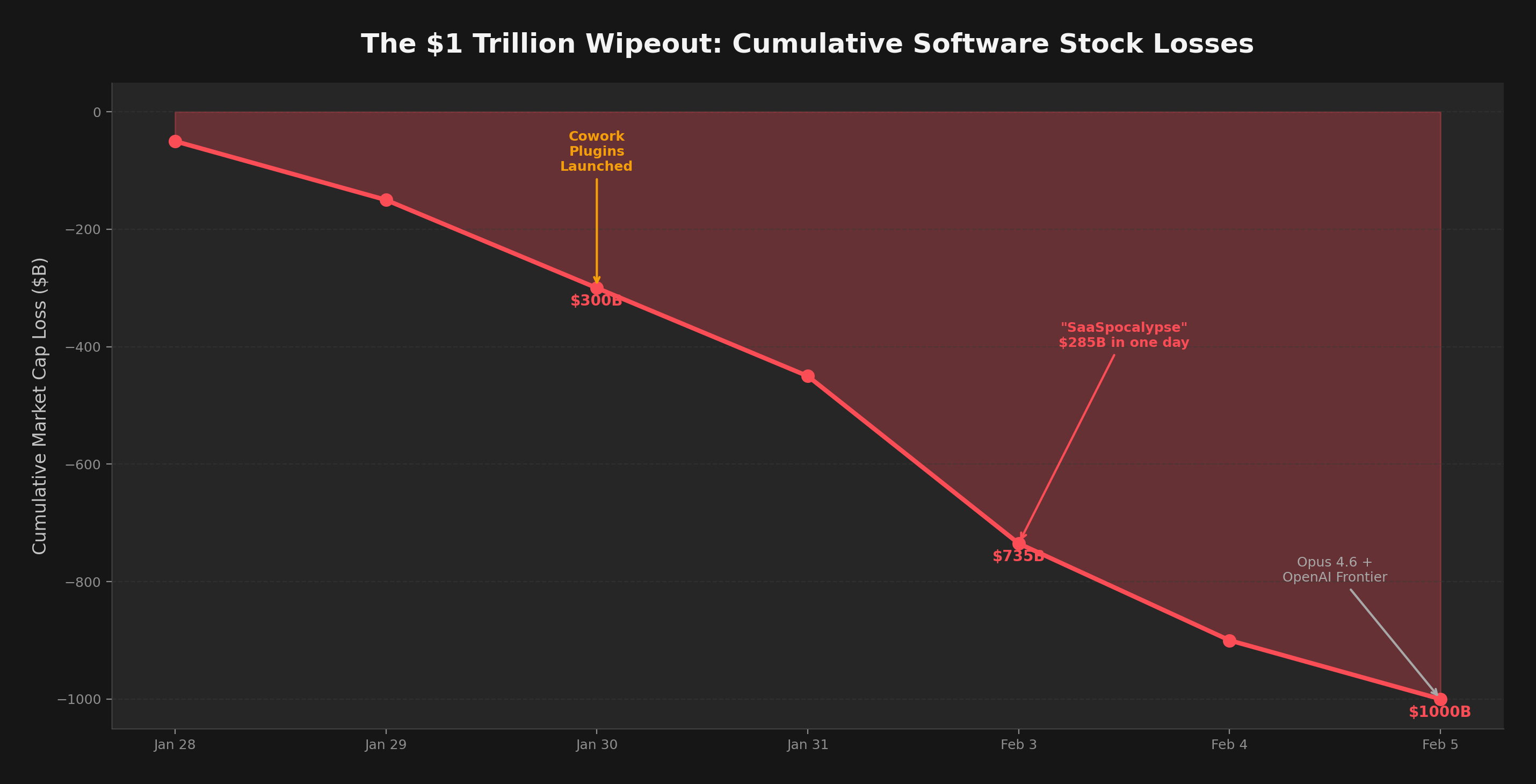
On January 30, Anthropic added 11 open-source "starter" plugins to Cowork, targeting legal, sales, marketing, and data analysis workflows. The legal plugin was the most disruptive — capable of contract review, NDA triage, compliance checks, and templated legal responses, all configurable to an organization's playbook.
The market didn't just see a new AI product. It saw a concrete demonstration that AI could enter highly specialized, high-margin professional services — and the selloff began.
Jeffrey Favuzza of Jefferies' equity trading desk coined the term. Bloomberg described software sentiment as "radioactive". JPMorgan's Toby Ogg said the sector is "now being sentenced before trial." Goldman Sachs' US software basket fell 6% — its biggest single-day decline since the April 2025 tariff selloff.
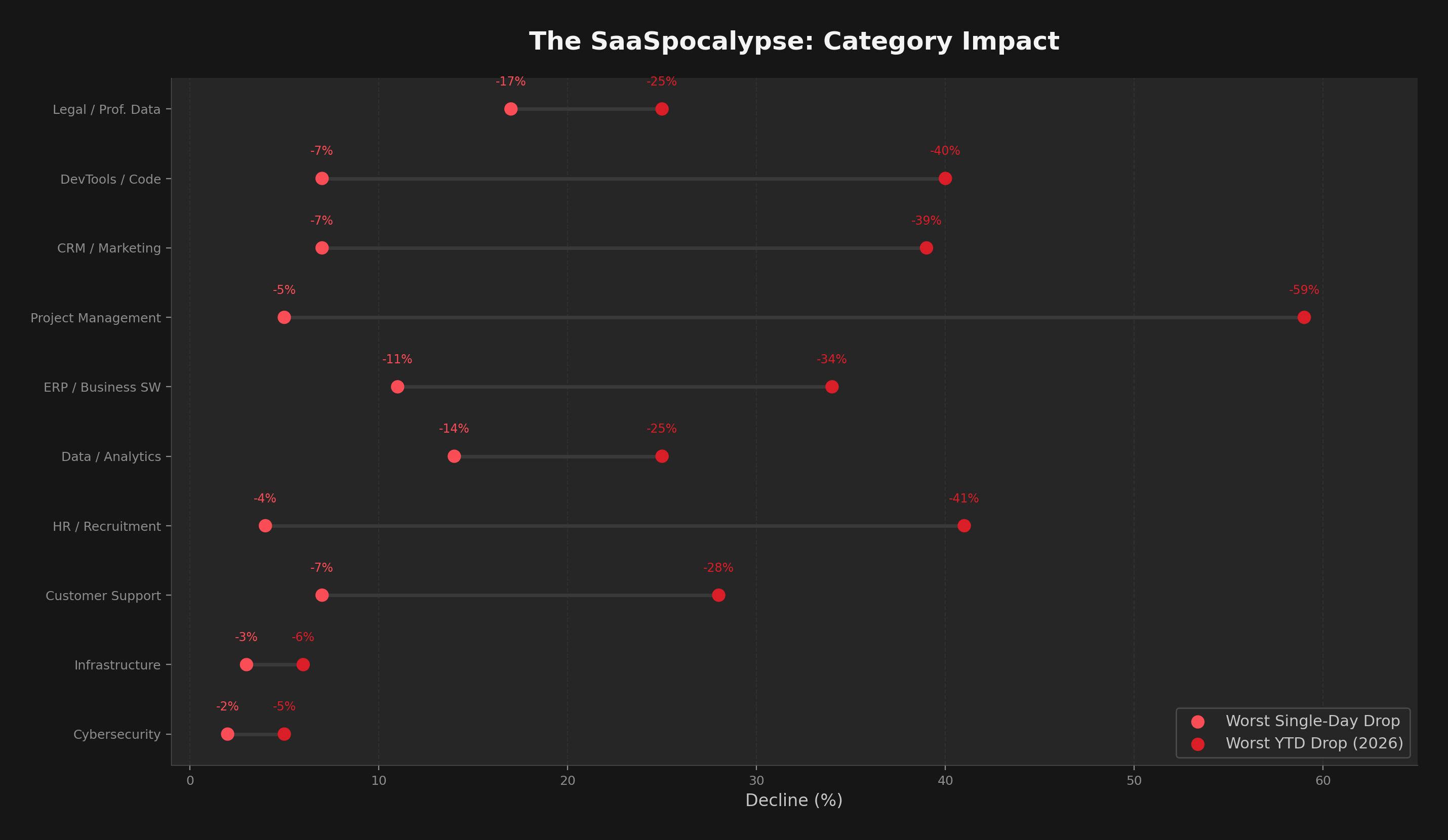
The selloff was not uniform. Some categories were devastated while others barely flinched. The pattern reveals which business models are most vulnerable to AI disruption.
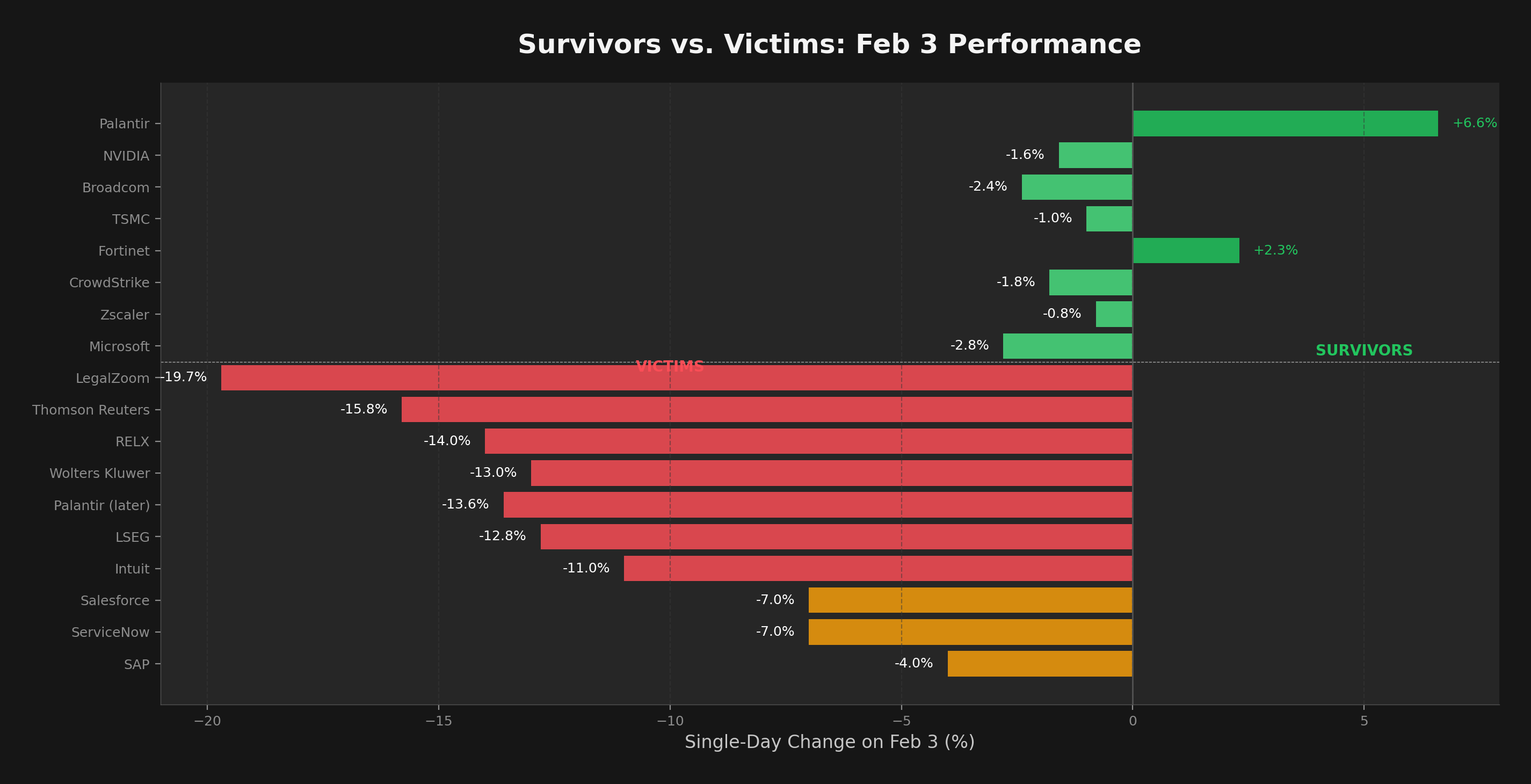
Anthropic's legal plugin landed like a bomb. LegalZoom fell 19.7% in a single day. Thomson Reuters posted its largest single-day drop on record (-15.8%), erasing ~$8.2B in market cap. RELX (parent of LexisNexis) saw its worst day since 1988 (-14%). Wolters Kluwer dropped 13%.
The logic was straightforward: if AI can do contract review, NDA triage, and compliance checks, the premium pricing for curated legal databases faces an existential threat.
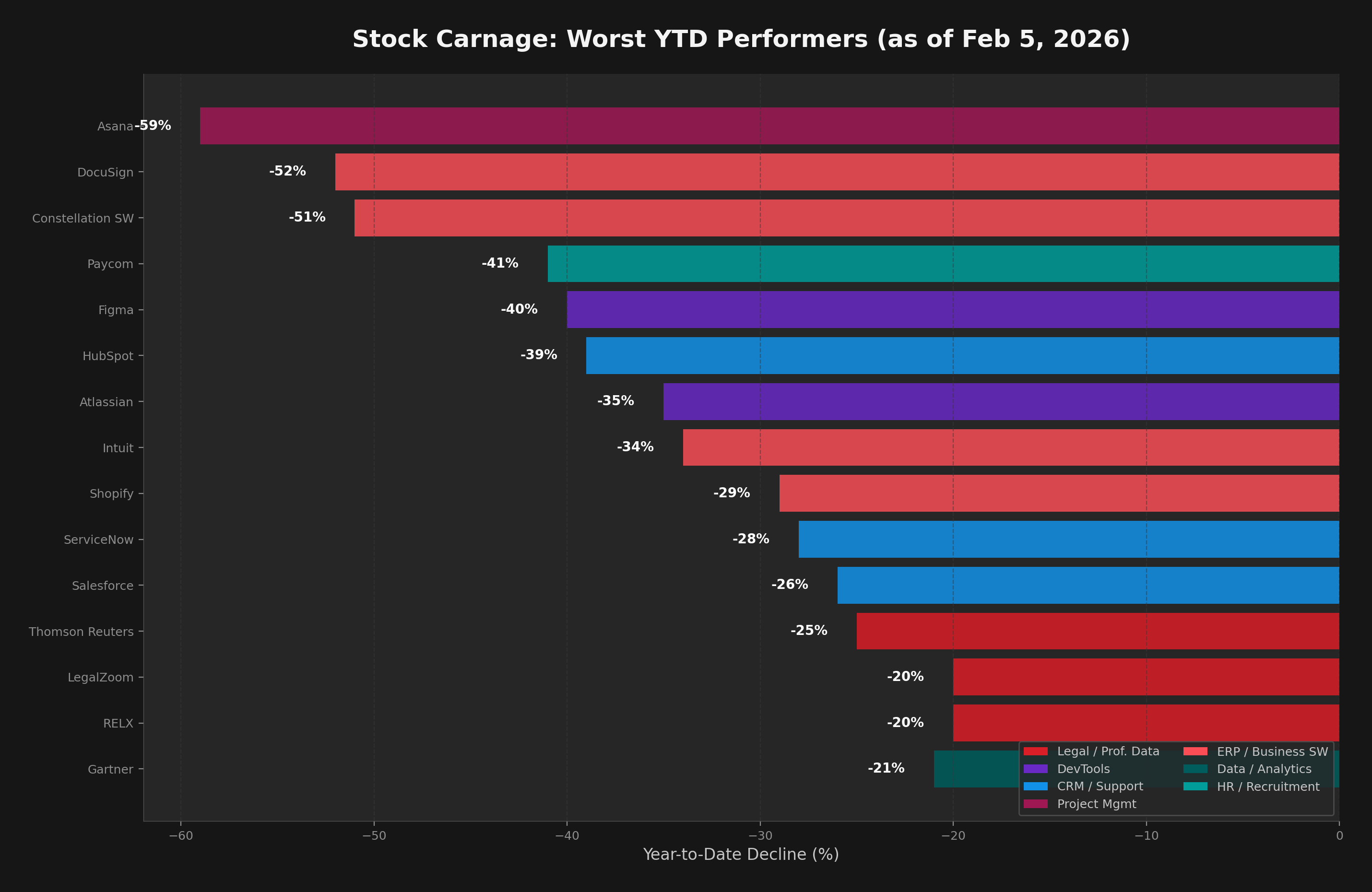
The broader SaaS carnage was driven by a single thesis: AI agents reduce headcount, which reduces seats, which reduces per-seat revenue. Jason Lemkin of SaaStr framed it simply: "If 10 AI agents do the work of 100 sales reps, you don't need 100 Salesforce seats anymore."
| Company | Category | YTD Decline | Single-Day (Feb 3) |
|---|---|---|---|
| Asana | Project Mgmt | -59% | -- |
| DocuSign | Business SW | -52% | -- |
| Constellation SW | Holding Co | -51% | -- |
| Figma | DevTools | -40% | -- |
| HubSpot | CRM/Marketing | -39% | -- |
| Atlassian | DevTools/PM | -35% | -- |
| Intuit | Financial SW | -34% | -11% |
| Salesforce | CRM | -26% | -7% |
| ServiceNow | IT Workflows | -28% | -7% |
| Thomson Reuters | Legal Data | -25% | -15.8% |
| LegalZoom | Legal Services | -40%+ | -19.7% |
| Adobe | Creative SW | -18% | -6.9% |
The selloff rippled globally. India's Nifty IT Index fell 5.87% intraday on Feb 4 — its steepest drop since March 2020. Infosys fell 7.1%, TCS 6%, Wipro 5%. In Europe, SAP lost $40B in market cap (-16% in one week). Advertising holding companies WPP (-12%), Omnicom (-11.2%), and Publicis (-9%) were hit as AI marketing automation fears spread.
The most revealing pattern in the selloff is what happened to the infrastructure layer — the cloud platforms and ERP systems that sit beneath SaaS applications. The market drew a sharp line: pure infrastructure held, hybrid plays wobbled, and per-seat ERP got hammered.
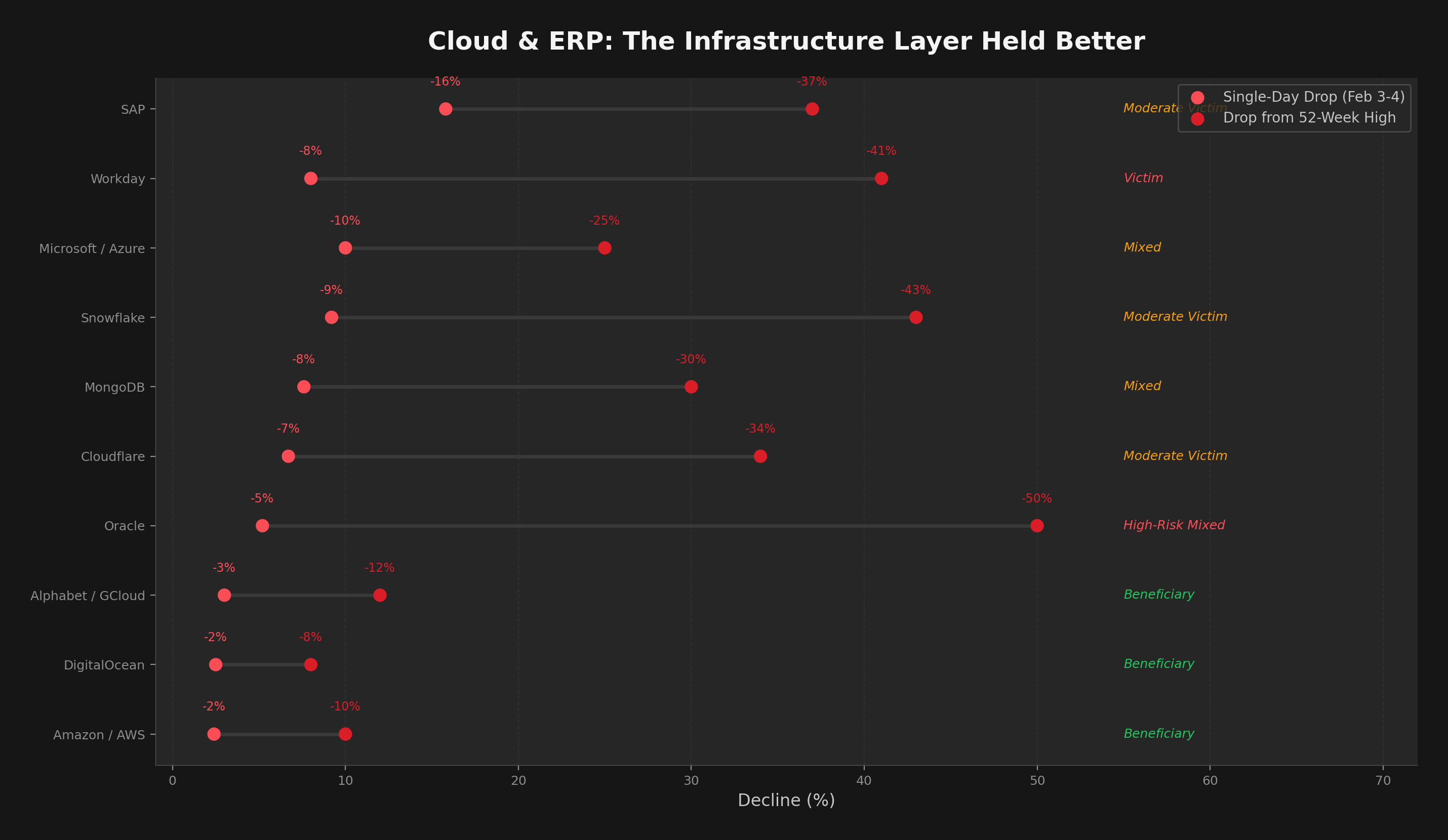
Amazon/AWS dropped just 2.4% on Feb 4 and remained positive YTD (~+4%). AWS is capacity-constrained, not demand-constrained — AI agents need compute regardless of which SaaS companies they displace. Alphabet/Google Cloud reported a 48% YoY surge in cloud revenue and a backlog that jumped 55% sequentially to $240 billion. CEO Sundar Pichai defended a staggering $175-185B capex plan for 2026, stating supply constraints — not demand — remain the binding issue.
DigitalOcean was the least affected of all companies researched (-2.5% single day). Bank of America upgraded it to Buy, noting its "drive into AI is leading to actual demand and significant operational leverage."
Microsoft was uniquely caught between two narratives. As Azure, it's an infrastructure beneficiary (+39% cloud growth). As Office 365 and Dynamics, it faces SaaS seat disruption fears. The result: -10% post-earnings and -25% from peak. Stifel downgraded MSFT to Hold, though Seeking Alpha called the selloff "irrational SaaSpocalypse fears" given Microsoft's 27% stake in OpenAI (worth ~$135B).
Snowflake fell 9.2% on Feb 3 despite being a data platform, not a pure SaaS play. The "basket-style" selloff was indiscriminate. MongoDB dropped 7.6% — AI needs databases, but the market hasn't decided if MongoDB is infrastructure or a displaced middleman. Cloudflare fell 6.7%, though BTIG upgraded it to Buy the next day.
SAP faced a double whammy: disappointing cloud guidance and the SaaSpocalypse. It fell 15.8% on earnings (its biggest daily loss since 2020) with an additional 3.3% on Feb 3-4 — over $40 billion in market cap erased. Palantir's CTO publicly claimed AI could compress "complex SAP ERP migrations from years to 2 weeks," positioning AI as a direct replacement threat.
"AI agents will massively push the boundaries of the performance of SaaS solutions, but not replace them. There are about 20,000 legal jurisdictions worldwide and complying with applicable regulation is a major reason why people trust vendors like SAP."
— Christian Klein, CEO of SAPOracle presents the highest-risk profile: theoretically an AI infrastructure beneficiary, but weighed down by $250 billion in long-term leasing commitments tied to data centers and plans to raise $45-50B in debt for AI buildout. It's down over 50% from its September peak. Morgan Stanley warned Oracle's expansion leaves "little room for error."
Workday may be the most exposed ERP company (-41% from high). CEO Carl Eschenbach called the selloff "overblown" at Davos — but then announced $135 million in restructuring charges including layoffs, undermining his own defense.
The deeper the infrastructure layer, the safer the company. AWS and Google Cloud barely flinched because AI agents consume more compute, not less. Snowflake and MongoDB sit one layer up and got moderate hits. SAP and Workday are the application layer — exactly where AI agents threaten to replace human workflows and per-seat pricing. The market is pricing a clear stack hierarchy.
Not everyone was a victim. A clear pattern emerged: companies that supply the infrastructure for AI or whose products become more necessary because of AI were either resilient or outright beneficiaries.
Palantir rose 6.6% on Feb 3 — the worst day of the selloff. Its Q4 earnings call positioned the company as an AI disruptor, claiming it could compress SAP ERP migrations from "years" to "weeks." The market classified Palantir as a company wielding AI against incumbents, not being disrupted by it.
NVIDIA, Broadcom, and TSMC barely moved. The logic is simple: more AI disruption = more GPU demand. NVIDIA has a $10B investment in Anthropic itself. Broadcom's AI-related revenue is projected to hit $46 billion in 2026 (+134% YoY).
Cybersecurity emerged as the anti-disruption sector. Fortinet actually gained 2.3%. CrowdStrike dropped just 1.8%, Zscaler only 0.8%. Morgan Stanley projects cybersecurity spending will grow at 12% CAGR through 2028. More AI agents = more attack surface = more security spend.
Bank of America's Vivek Arya identified the core logical flaw in the selloff: investors were simultaneously pricing in (1) AI capex collapsing due to poor ROI, and (2) AI being so powerful it destroys all SaaS. "Both outcomes cannot occur at once." BofA called it "internally inconsistent" and compared it to the DeepSeek overreaction of January 2025.
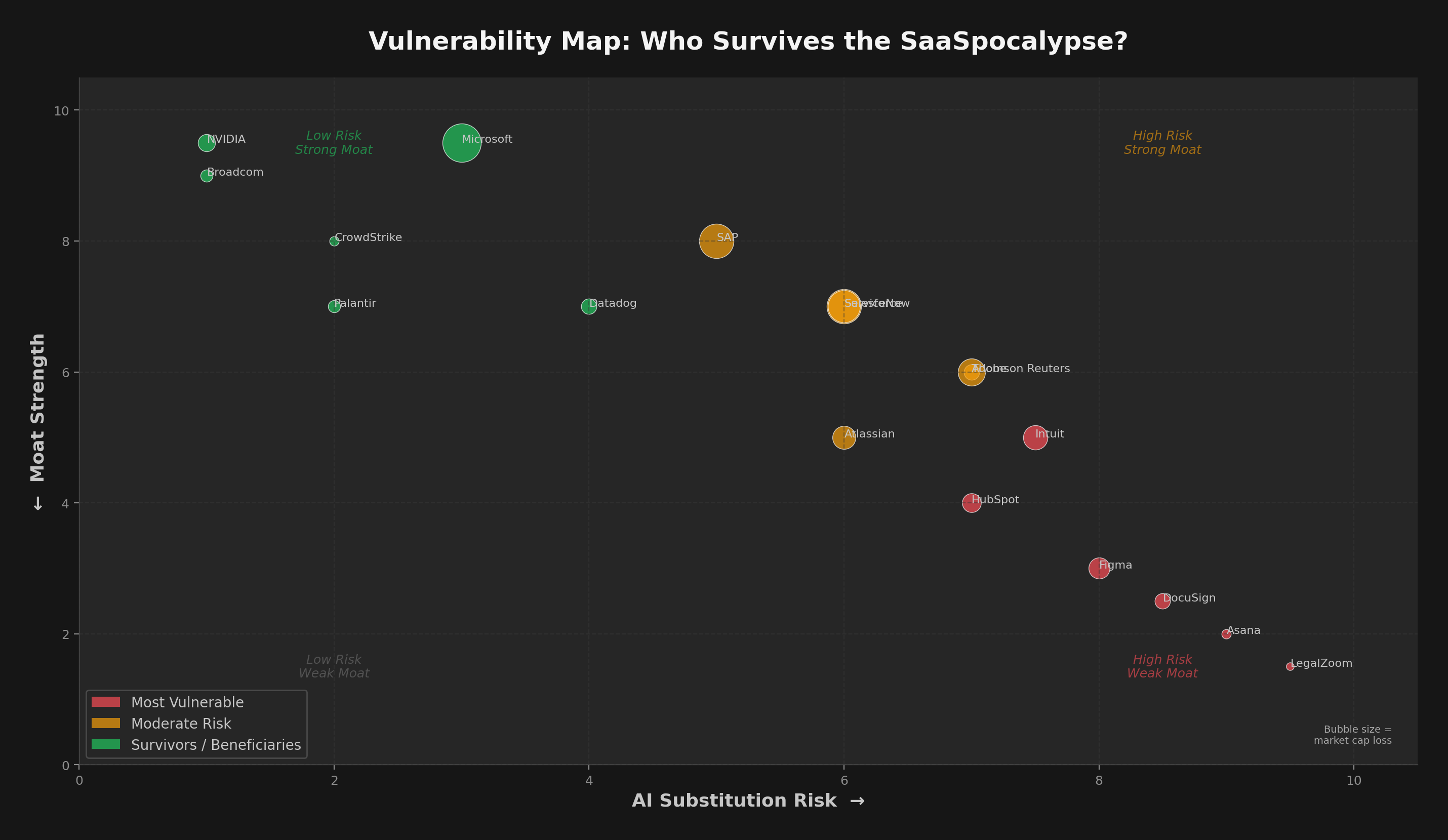
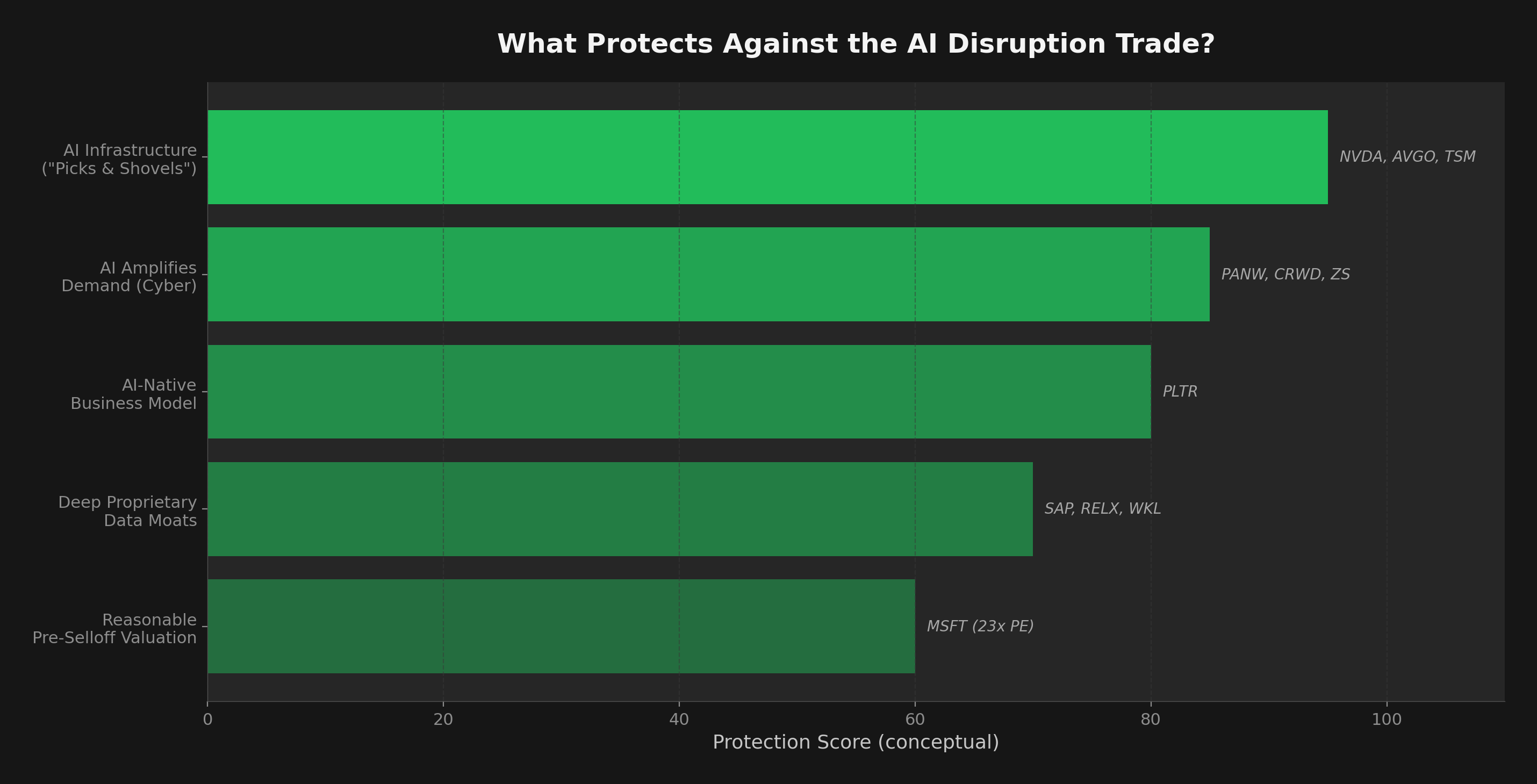
Across all the data, five protective characteristics emerge that determine whether a company survives the AI disruption trade.
| Protective Factor | Why It Works | Examples |
|---|---|---|
| "Picks & Shovels" | Supply AI infrastructure — more disruption = more demand | NVDA, AVGO, TSM, ANET |
| AI Amplifies Demand | More AI agents create more of the problem you solve | PANW, CRWD, ZS, FTNT |
| Proprietary Data Moats | Irreplaceable datasets that general AI can't access | SAP, RELX, WKL (recovering) |
| AI-Native Model | Built to wield AI, not to be disrupted by it | PLTR |
| Reasonable Valuation | Lower PE provided a floor; less speculation to unwind | MSFT (23x PE) |
At the other end, the most destroyed companies shared common traits: thin moats, seat-based pricing, and products that could be described as "a SQL wrapper with a billing system." Microsoft CEO Satya Nadella warned that AI agents could disrupt business applications functioning as "CRUD databases with business logic."
The market is drawing a clear line: if you own the data layer or serve as AI infrastructure, you win. If you're "just the interface," you face existential risk.
The reaction split sharply between institutional panic and contrarian optimism.
"Software companies shrivel up and die."
— Jim Cramer, CNBC Mad Money"We are now in an environment where the sector isn't just guilty until proven innocent, but is now being sentenced before trial."
— Toby Ogg, JPMorgan"An industry that spends vastly more on sales and marketing than on engineering was always vulnerable."
— Sridhar Vembu, CEO of Zoho"This notion that the software industry is in decline and being replaced by AI is the most illogical thing in the world."
— Jensen Huang, CEO of NVIDIA"Chaos creates opportunity! A lot of money is about to be made."
— Byron Deeter, Bessemer Venture Partners"In the 20-year history of Box, this is the most exciting moment we've ever had."
— Aaron Levie, CEO of BoxApproximately 85% of SaaS companies have now moved toward some form of usage-based pricing. ServiceNow introduced "Assist Packs" — consumption-based tokens that monetize AI work rather than human logins. The fundamental question for 2026, per SaaStr's Jason Lemkin: "Will enterprises spend on specific software, or redirect budgets to AI?"
Perhaps the most striking signal: retail investors on Stocktwits registered "extremely bullish" sentiment across nearly all major SaaS names — a stark divergence from institutional "get me out" behavior. The market is experiencing a classic fear/greed split, with contrarians from Jensen Huang to Bessemer VC positioning this as a generational buying opportunity.
The most nuanced view comes from Zoho's Sridhar Vembu: "AI isn't the real villain. AI is the pin that is popping this inflated balloon." In other words, the correction may be real and overdue — but the catalyst (AI) is being conflated with the cause (overvaluation).
The SaaSpocalypse isn't just a stock market story. It's a signal about how AI is reshaping enterprise software economics. Three implications stand out:
Companies that are "just the UI" above commodity data are most at risk. If an AI agent can replicate what your vendor does by reading your data directly, that vendor's moat is thin. Prioritize vendors with proprietary data, regulatory compliance, or infrastructure-level lock-in.
Per-seat licensing is being replaced by consumption-based and outcome-based pricing. Budget planning needs to adapt. The short-term effect may be lower SaaS spend (fewer seats), but the medium-term effect is more volatile, harder-to-predict software costs as AI agents consume tokens.
The market is clearly rewarding companies that integrate AI into their platforms (Palantir, ServiceNow's Now Assist, Datadog) versus those whose products AI can substitute entirely (Asana, DocuSign, LegalZoom). For your own tech stack: build with AI, not against it.
Published February 5, 2026 · Analysis by aictrl.dev