Why throwing more AI agents at a problem usually makes it worse — and what the data says about when it actually works.
In January 2026, the multi-agent AI coding movement hit a wall of data. While SWE-Bench Verified scores climbed past 70% — fueling headlines about AI agents that can "solve real bugs" — a quieter set of benchmarks told a very different story.
ACE-Bench, presented at ICLR 2026, tested agents on what developers actually do: build complete features across multiple files, with tests, documentation, and integration. The result? Claude Sonnet 4 with OpenHands — the same system scoring 70.4% on SWE-Bench — achieved just 7.5% on ACE-Bench.
That's not a typo. A 10x performance drop when moving from isolated bug fixes to end-to-end feature development.
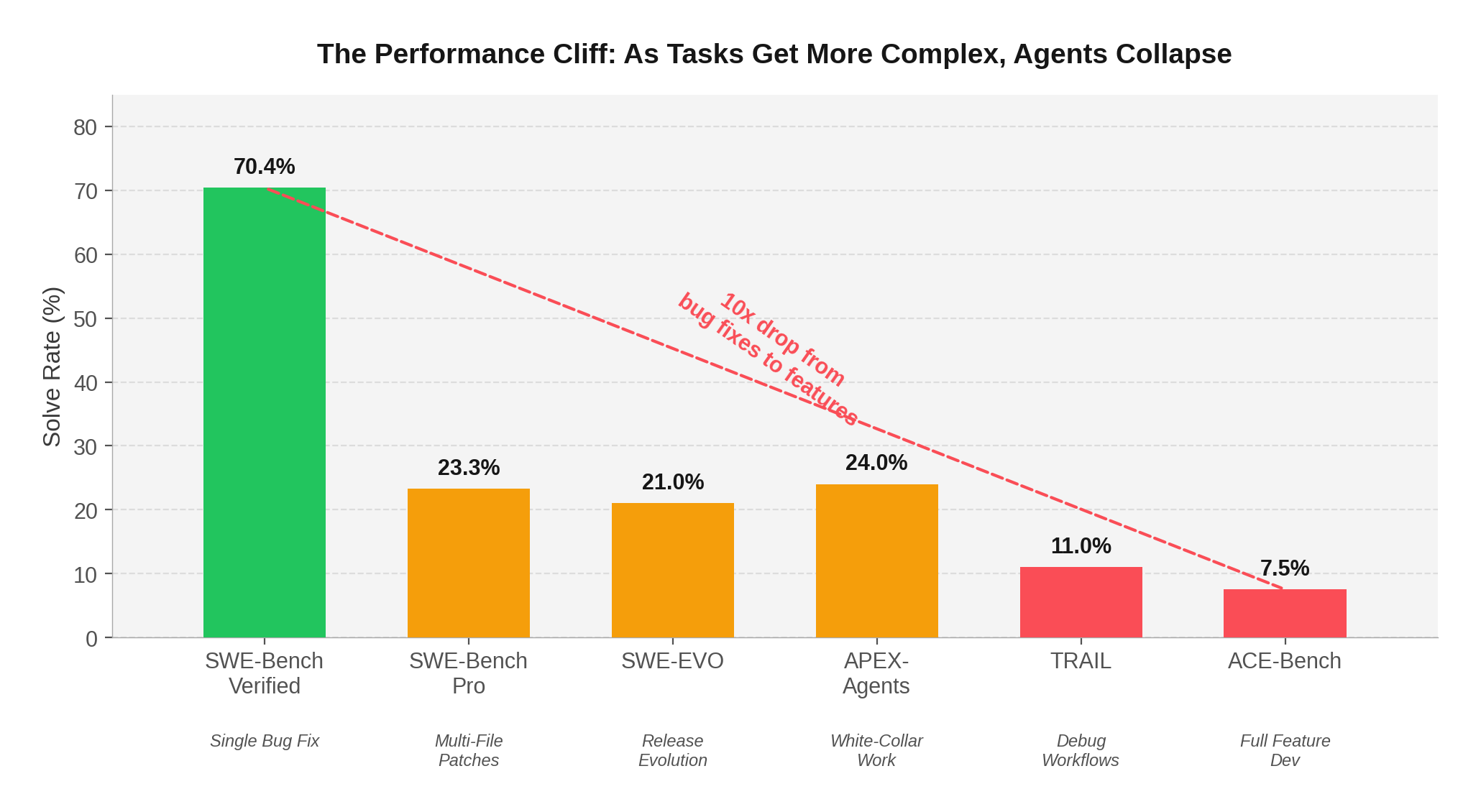
The pattern is consistent across every new benchmark released in the past three months:
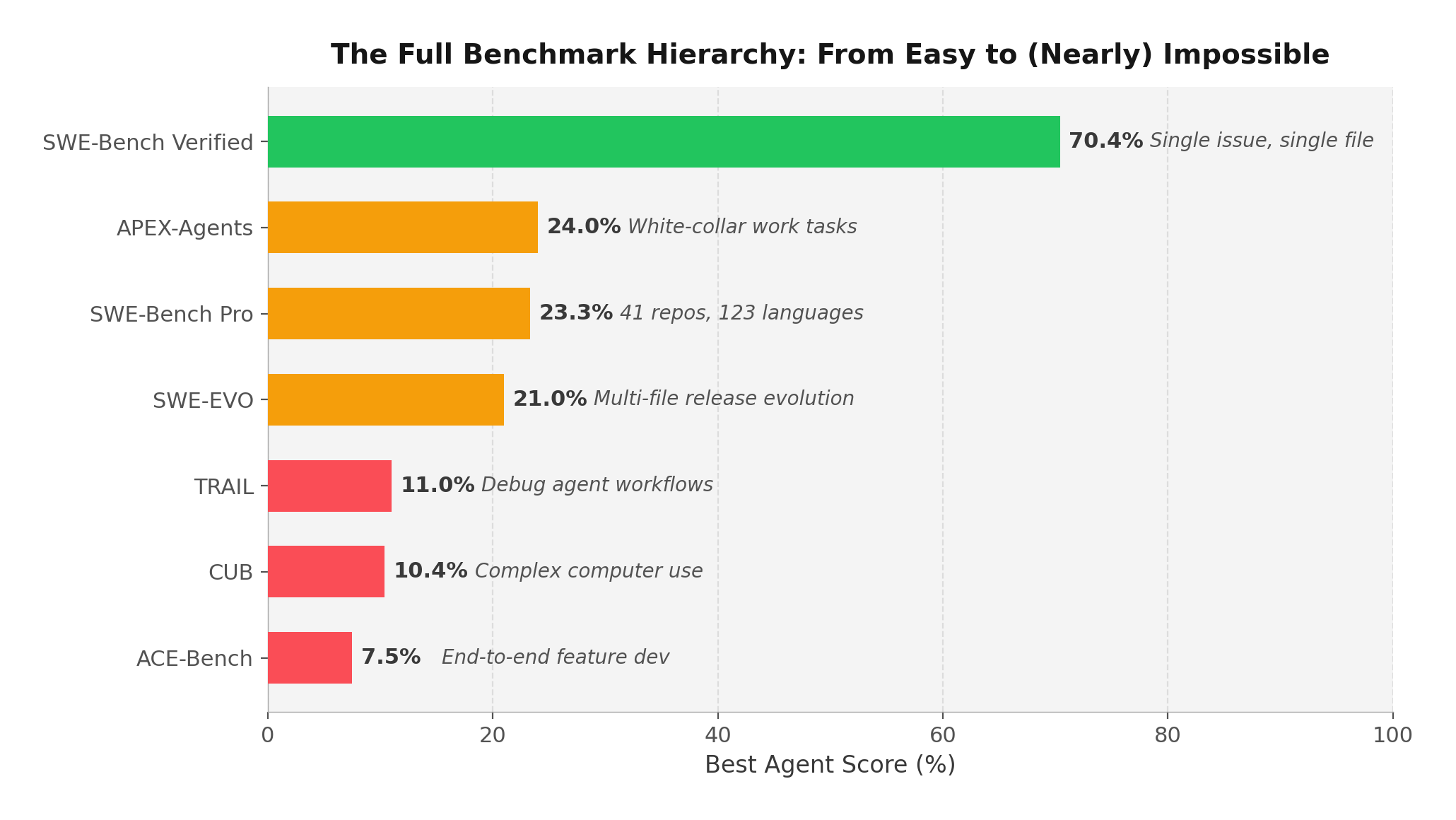
SWE-EVO tested agents on release-note-driven evolution — evolving a codebase across an average of 21 files per task. GPT-5 scored 21%, down from 65% on SWE-Bench Verified. TRAIL from Patronus AI asked models to debug agent workflows themselves: Gemini 2.5 Pro achieved just 11% joint accuracy. APEX-Agents measured white-collar work tasks (consulting, investment banking, law) and the best model, Gemini 3 Flash, scored 24%.
The Bottom Line
If your AI coding strategy is built on SWE-Bench scores, you're optimizing for the easiest 20% of real software engineering work. The benchmarks that matter — long-horizon evolution, cross-file features, multi-domain reasoning — show agents succeeding less than 25% of the time.
The intuitive response to these poor scores is: "use more agents." If one agent scores 7.5%, surely a team of specialized agents working together can do better?
In December 2025, Google Research, Google DeepMind, and MIT published what may be the most important multi-agent study to date: "Towards a Science of Scaling Agent Systems." They evaluated 180 agent configurations and found something counterintuitive.
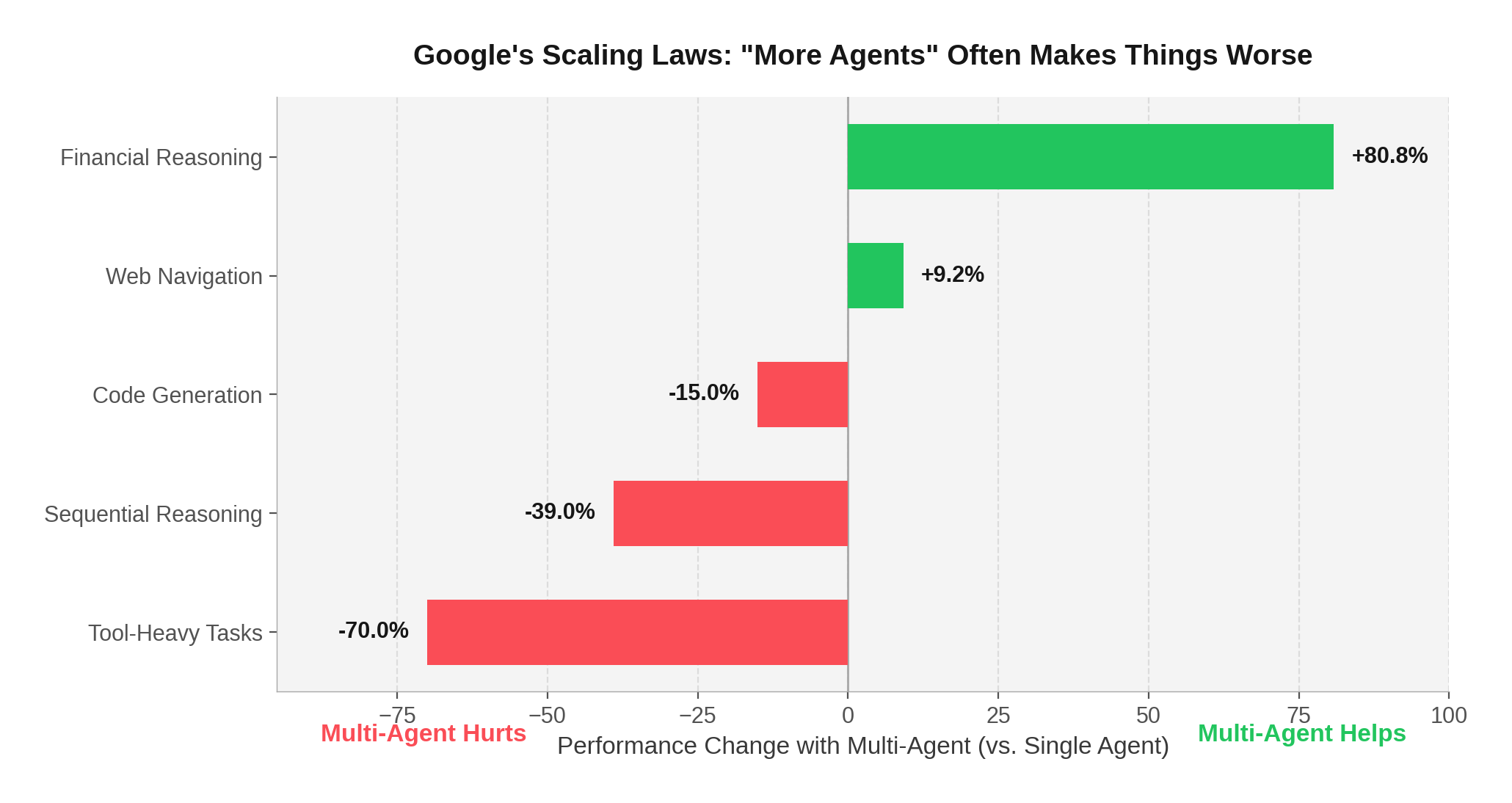
For sequential tasks, adding more agents made performance 39-70% worse.
The study identified three critical failure modes:
Tool-heavy tasks suffer from multi-agent overhead. When agents need to share state through tools (databases, APIs, file systems), the coordination cost often exceeds the parallelization benefit.
Once a single agent surpasses ~45% on a task, adding more agents yields diminishing returns. The coordination overhead begins to dominate, and extra agents introduce new failure modes without proportionally increasing success.
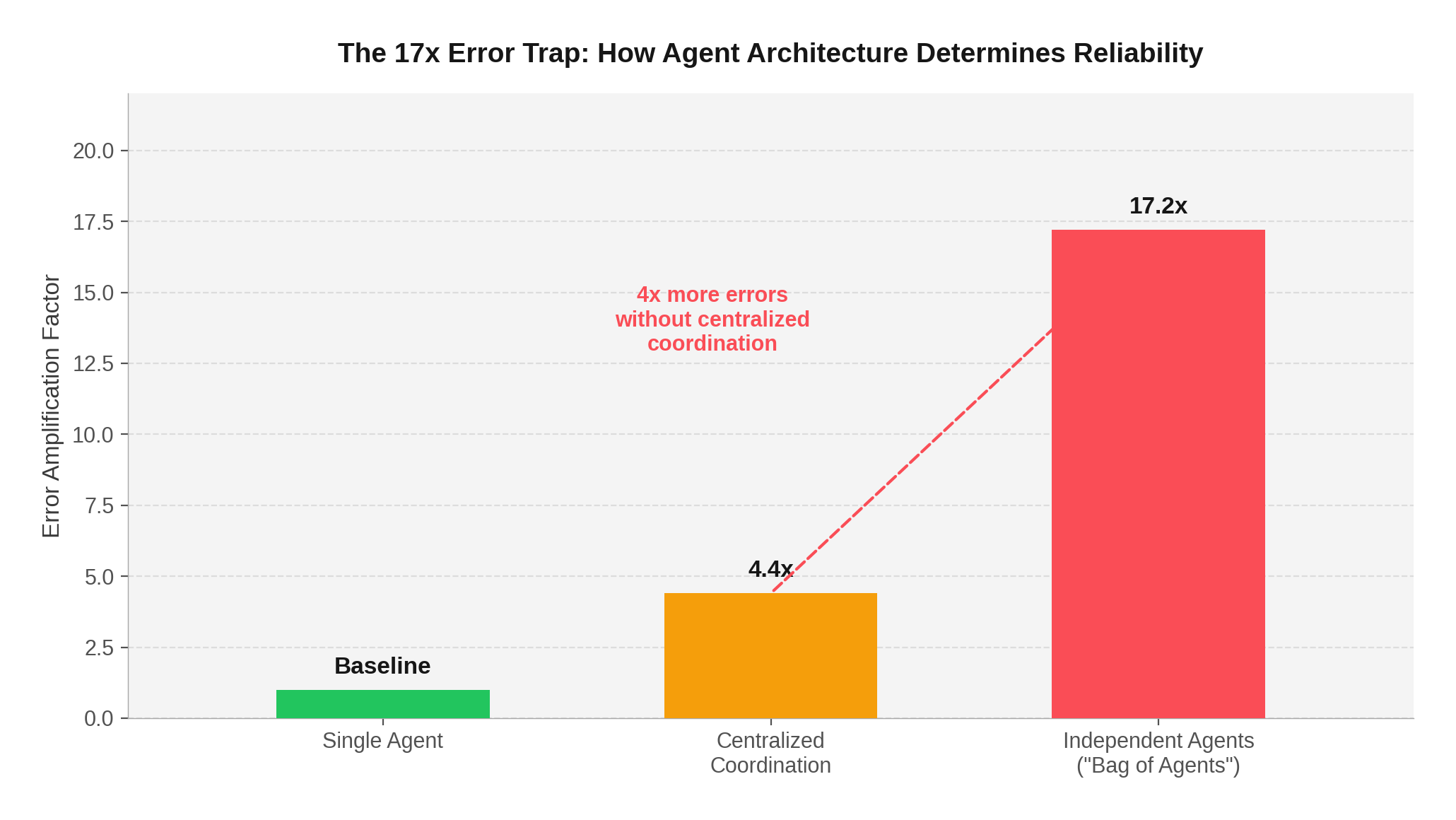
This is the killer finding. Independent agents running without centralized coordination amplify errors by 17.2x compared to a single agent. Even centralized coordination still amplifies errors 4.4x. The "bag of agents" pattern — common in early multi-agent implementations — is actively destructive.
When Multi-Agent Does Work
The data isn't all bad. Parallelizable tasks see genuine improvement: financial reasoning gained +80.8%, dynamic web navigation +9.2%. The key insight: multi-agent systems should decompose work into independent parallel tracks, not pipeline sequential reasoning through multiple agents.
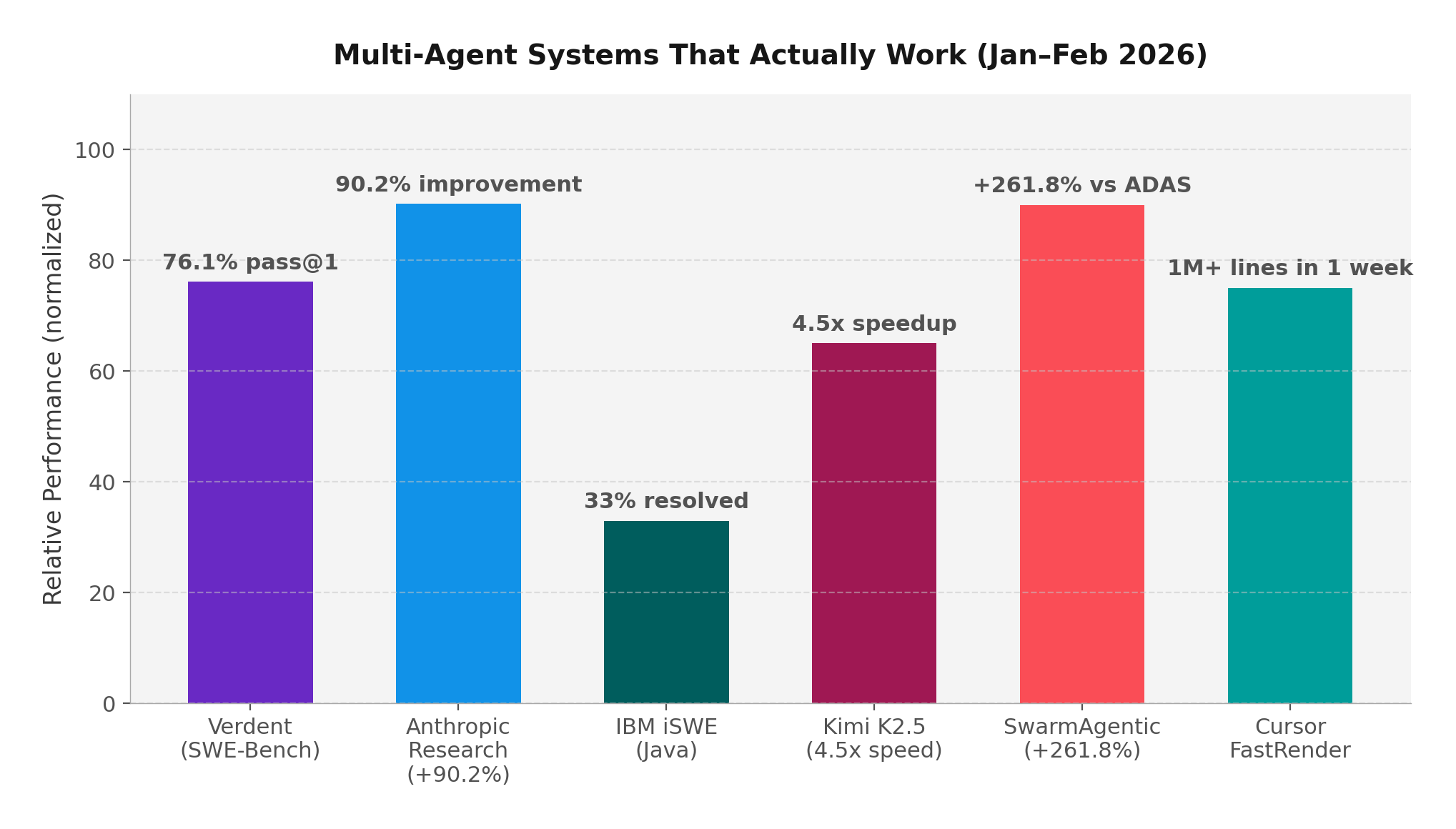
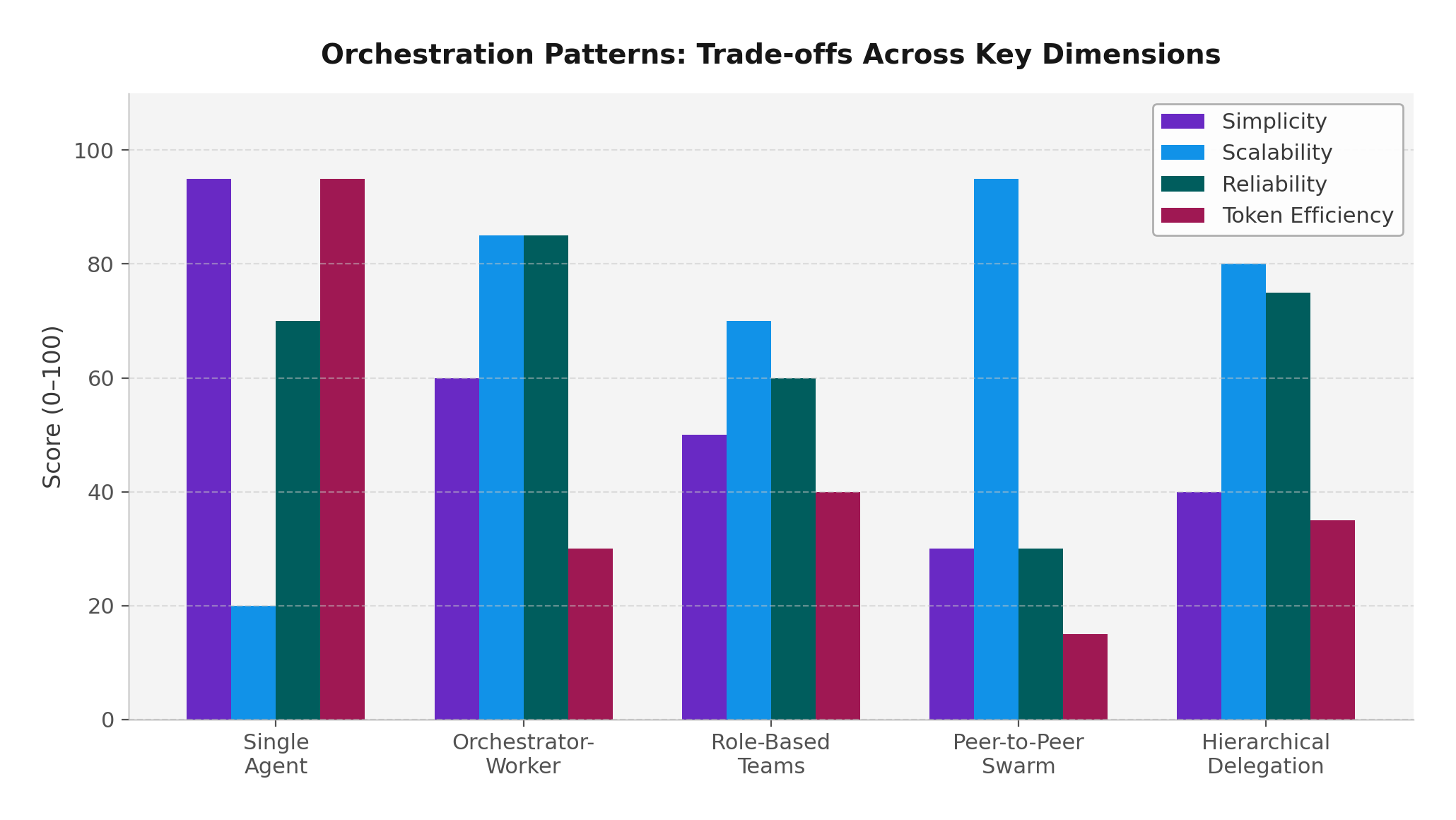
Against this backdrop of scaling failures, several multi-agent systems from January 2026 demonstrated genuine breakthroughs — but with a crucial pattern: they all use orchestrator-worker architectures with strict coordination.
Anthropic published their internal multi-agent architecture in detail. A Claude Opus 4 lead agent orchestrates parallel Claude Sonnet 4 subagents, achieving a 90.2% performance improvement over a single Opus 4 instance on complex research tasks.
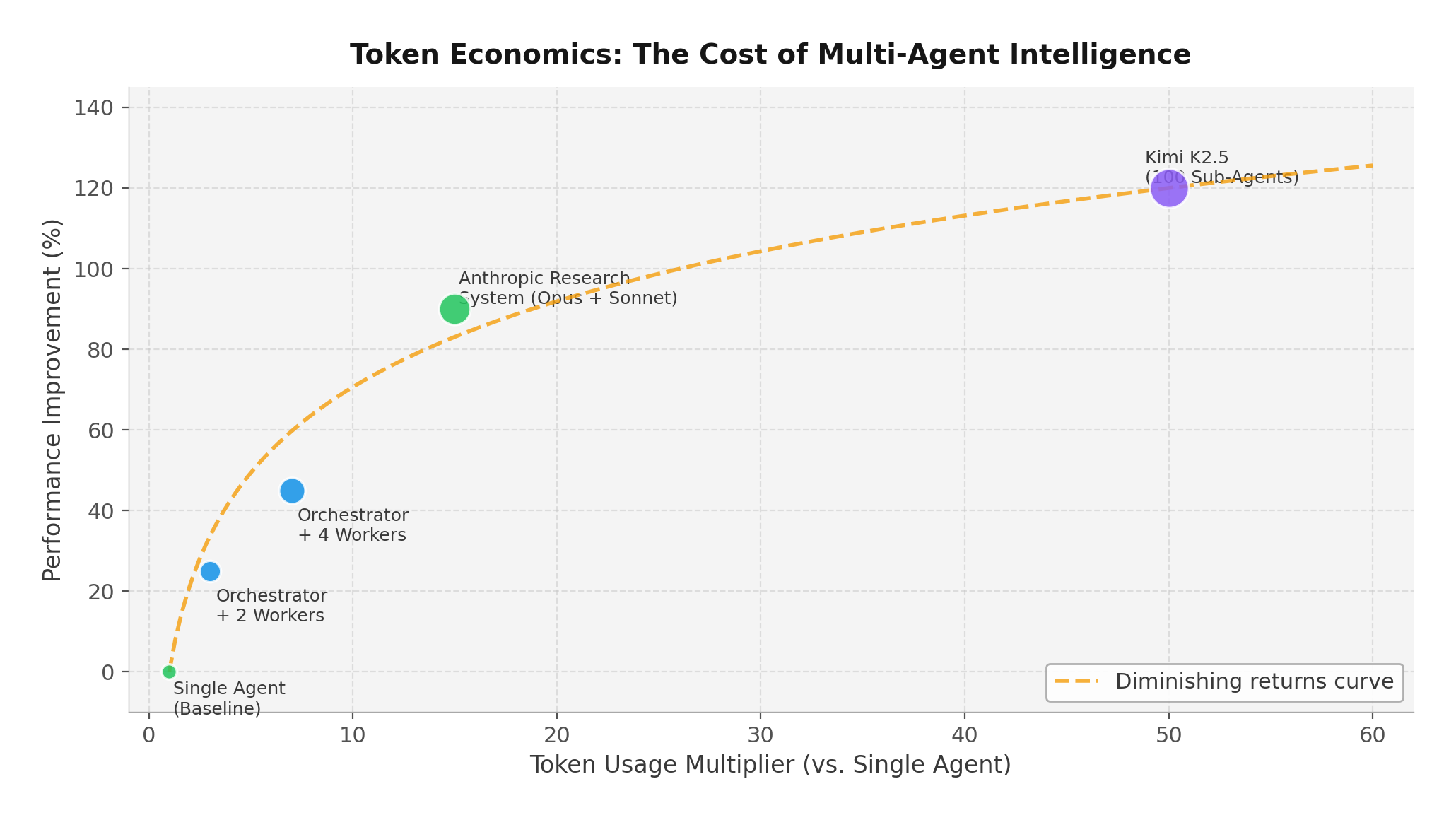
The trade-off? 15x token usage. This is not a cost-neutral improvement. It's a deliberate choice to spend more compute for significantly better results, with centralized orchestration preventing the error amplification that plagues independent swarms.
Verdent AI achieved 76.1% pass@1 (81.2% pass@3) on SWE-Bench Verified using a "plan-code-verify" cycle with parallel agents. No leaderboard tuning — this is a production system available as a VS Code extension.
Moonshot AI's Kimi K2.5 dynamically instantiates up to 100 sub-agents with 1,500 parallel tool calls. The system achieved strong results on HLE and SWE-Verified benchmarks while delivering a 4.5x speedup over single-agent execution.
Perhaps the most ambitious result: SwarmAgentic (arXiv:2506.15672) uses swarm intelligence to automatically generate entire agentic system architectures from scratch — not from templates. It achieved +261.8% relative improvement over ADAS on the TravelPlanner benchmark, suggesting the architecture itself can be the variable, not just the model.
Every successful multi-agent system has a hidden cost: massive token overhead. Anthropic's research system uses 15x more tokens. Kimi K2.5's 100 sub-agents consume orders of magnitude more than a single pass. This isn't a bug — it's the fundamental trade-off of multi-agent intelligence.
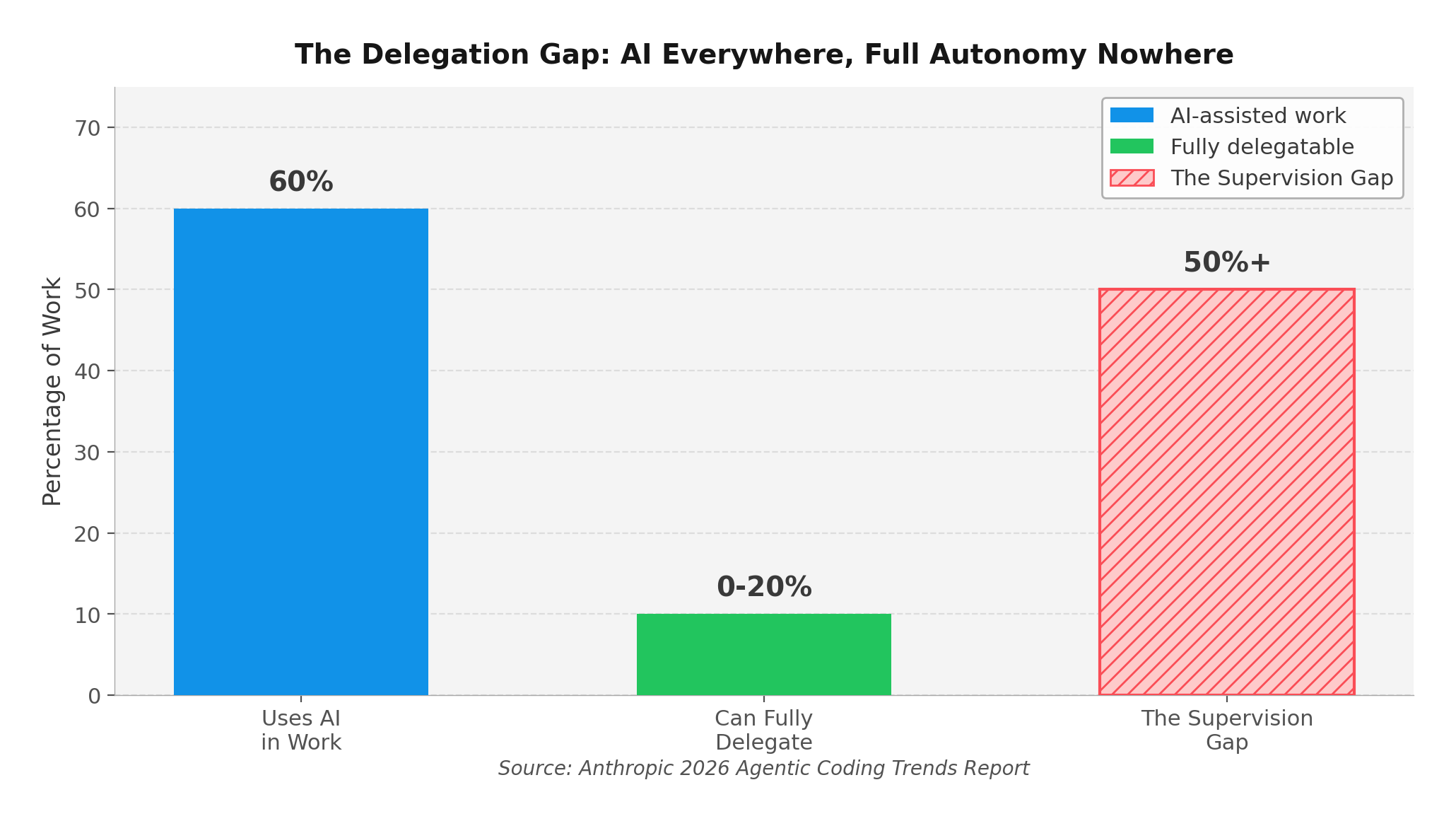
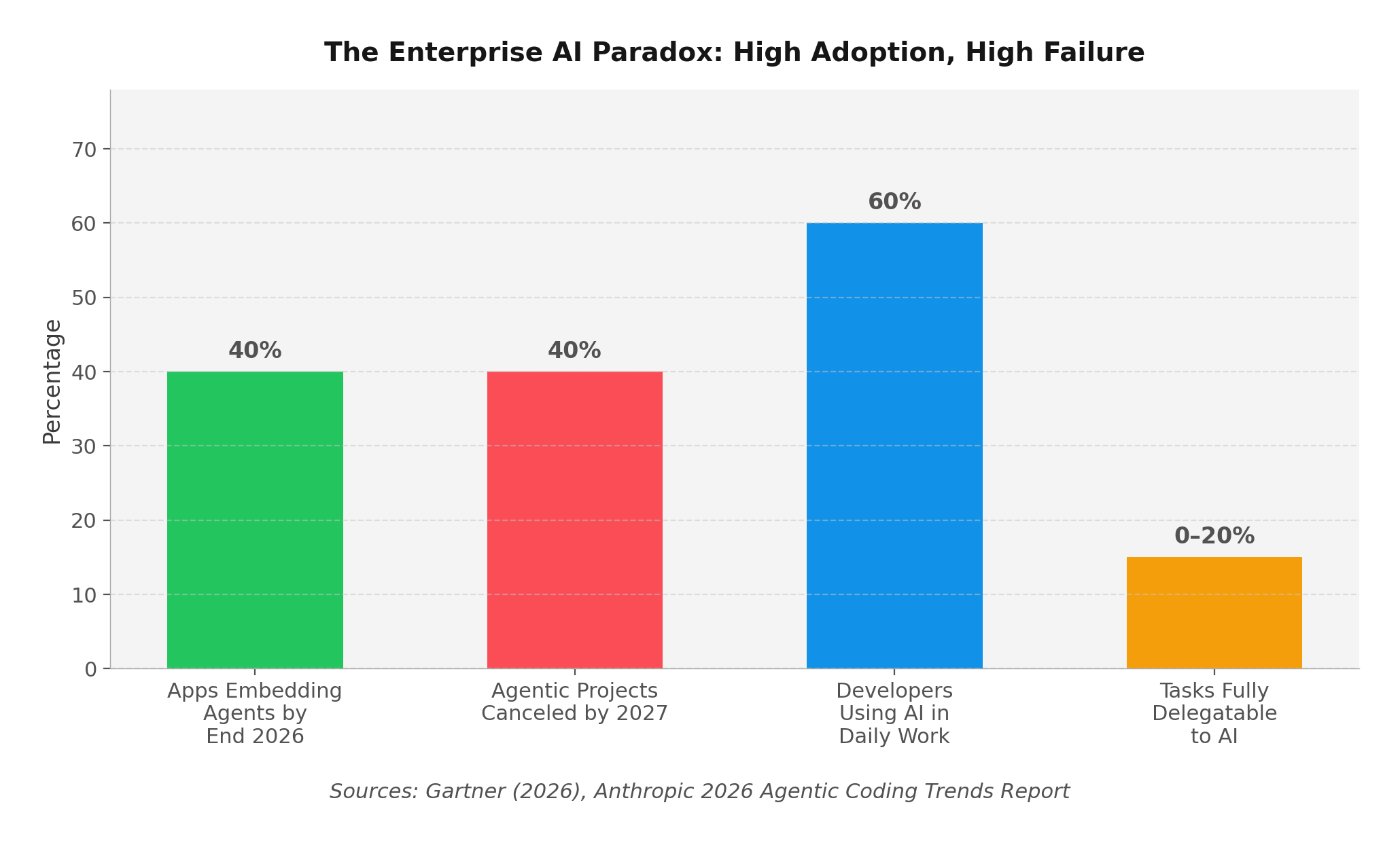
Anthropic's own Agentic Coding Trends Report (January 21, 2026) quantified this from the human side: developers use AI in roughly 60% of their work, but report being able to "fully delegate" only 0-20% of tasks. AI serves as a constant collaborator, but using it effectively still requires supervision, validation, and human judgment.
Case Study: Rakuten on Claude Code
Engineers at Rakuten used Claude Code to implement an activation vector extraction method in vLLM, a 12.5-million-line codebase. It finished in seven hours with 99.9% numerical accuracy. Impressive — but note: this was a well-defined, single-feature task. Not a month-long evolution project. The delegation gap applies even to the best tools.
Gartner's 2026 predictions created a headline paradox: 40% of enterprise applications will embed AI agents by end of 2026, yet 40% of agentic AI projects will be canceled by 2027.
This isn't a contradiction — it's a consequence. Companies are rushing to adopt multi-agent systems before understanding the fundamental constraints this data reveals.
BCG's 10-20-70 rule puts numbers on why: only 10% of effort should go toward the algorithm. 20% toward technology and data. 70% toward people and process changes. Yet most agentic AI investments focus exclusively on the algorithm.
Deloitte's 2026 AI Agent Orchestration report found that while MCP (Anthropic) and A2A (Google) protocols are gaining traction, the governance gap persists: only 21% of organizations have governance frameworks for agentic AI systems.
"The shift from human-in-the-loop to human-on-the-loop requires governance frameworks that most organizations haven't built yet. The tooling is outpacing the institutional capacity to use it safely."
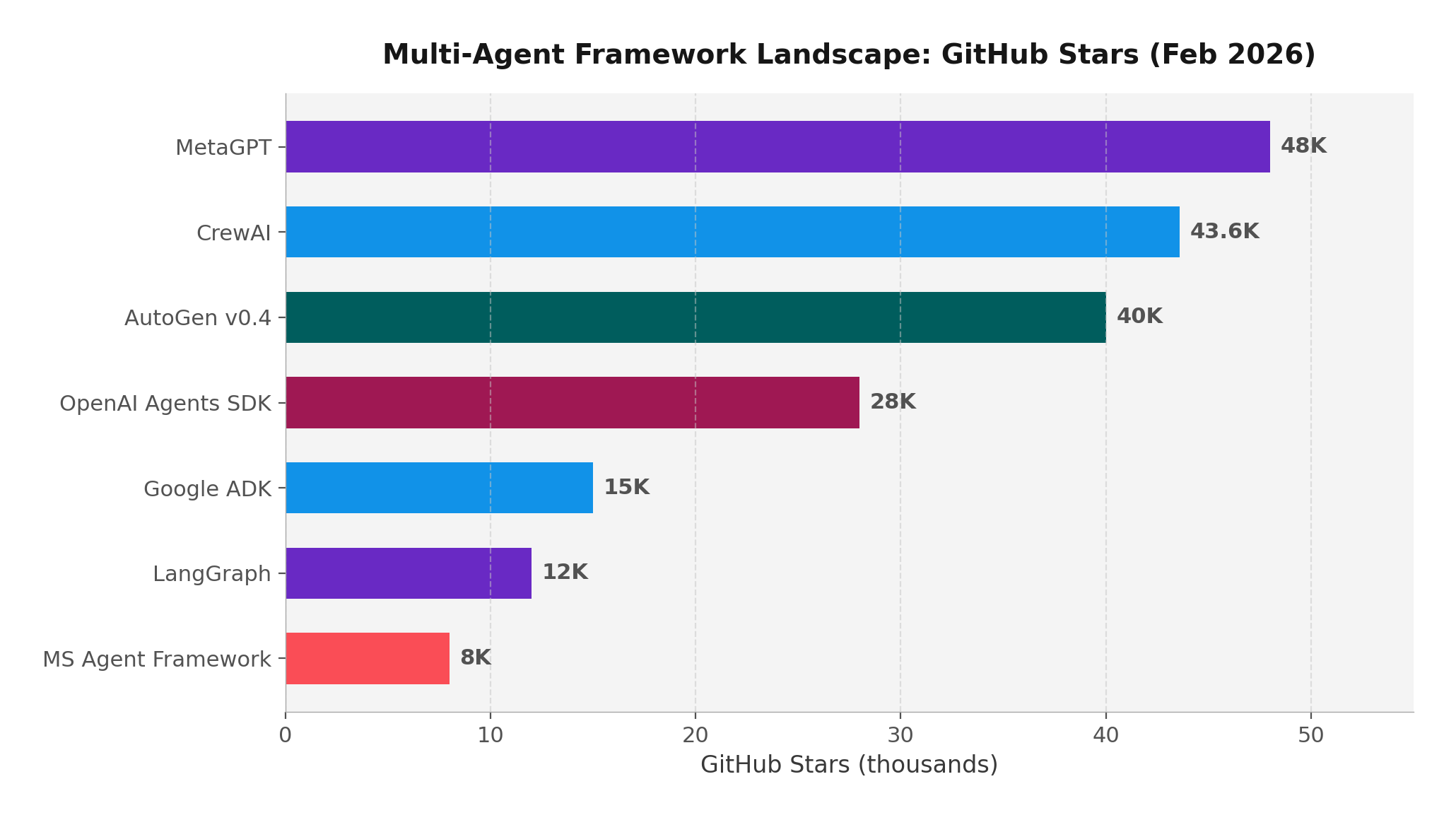
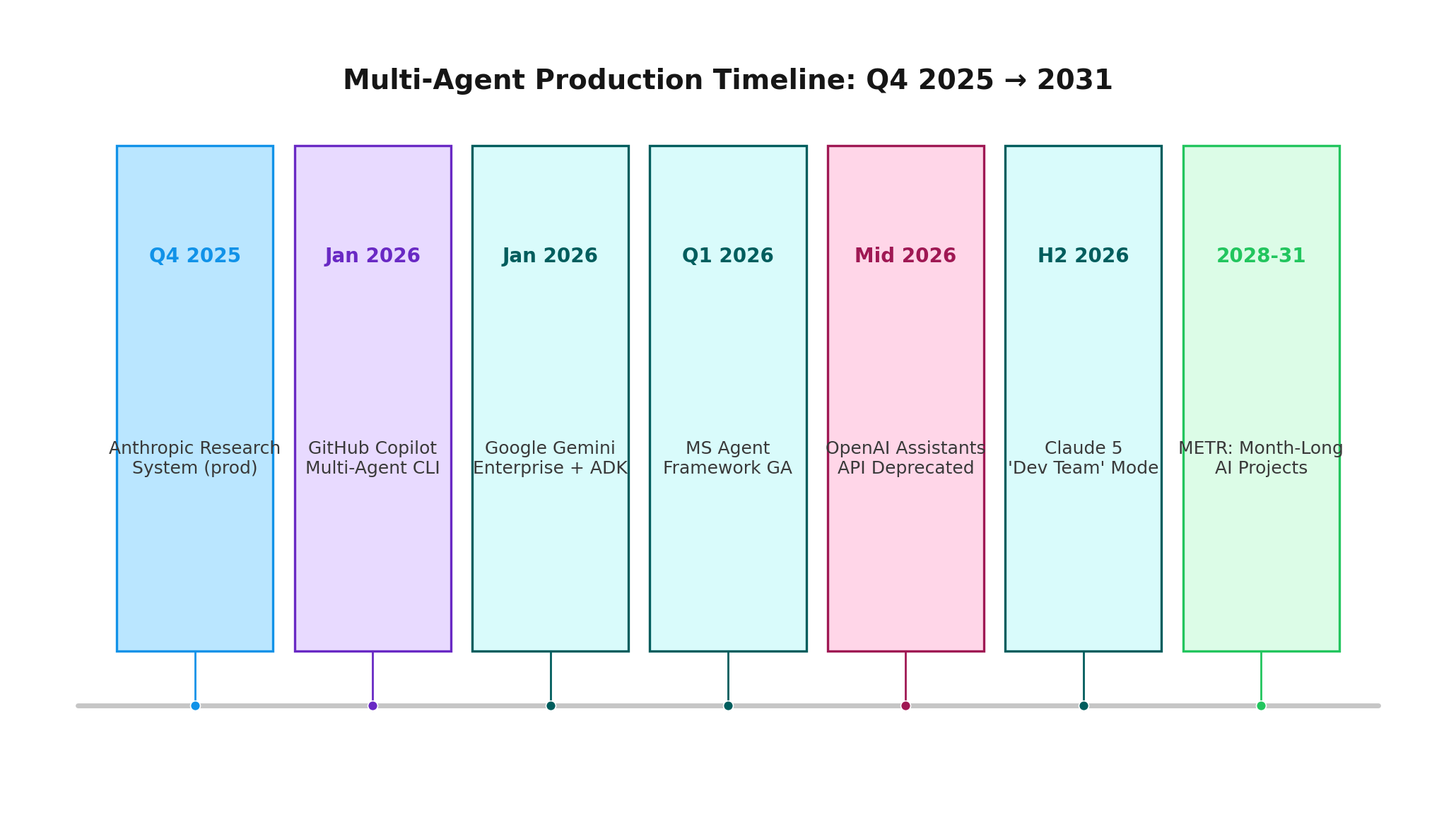
— Deloitte 2026 AI Agent Orchestration ReportThe tooling landscape for multi-agent systems is consolidating fast. January 2026 saw Microsoft announce Agent Framework 1.0 GA (merging AutoGen and Semantic Kernel, target Q1 2026), while OpenAI deprecated Swarm in favor of the production-ready Agents SDK. Google launched Agent Designer for no-code multi-agent orchestration.
The emerging consensus: production systems combine multiple frameworks. LangGraph for graph-based orchestration, CrewAI (43.6K stars, 1M downloads/month) for role-based team execution, and the platform SDKs (OpenAI Agents SDK, MS Agent Framework, Google ADK) for model-specific optimization.
Protocol standardization is also accelerating. Anthropic's MCP (Model Context Protocol) standardizes agent-to-tool connections, while Google's A2A (Agent-to-Agent Protocol) targets inter-agent communication. Both are being adopted across the ecosystem.
Claude Code's Swarm Mode
In late 2025, researchers discovered a fully-implemented multi-agent system called TeammateTool hidden in the Claude Code binary — 13 operations with complete infrastructure, feature-flagged off. Anthropic has since officially launched Swarm mode, making Claude Code the first developer tool from a frontier lab with native multi-agent orchestration. Multiple Claude instances collaborate in parallel via file-system-based coordination, each with isolated worktrees.
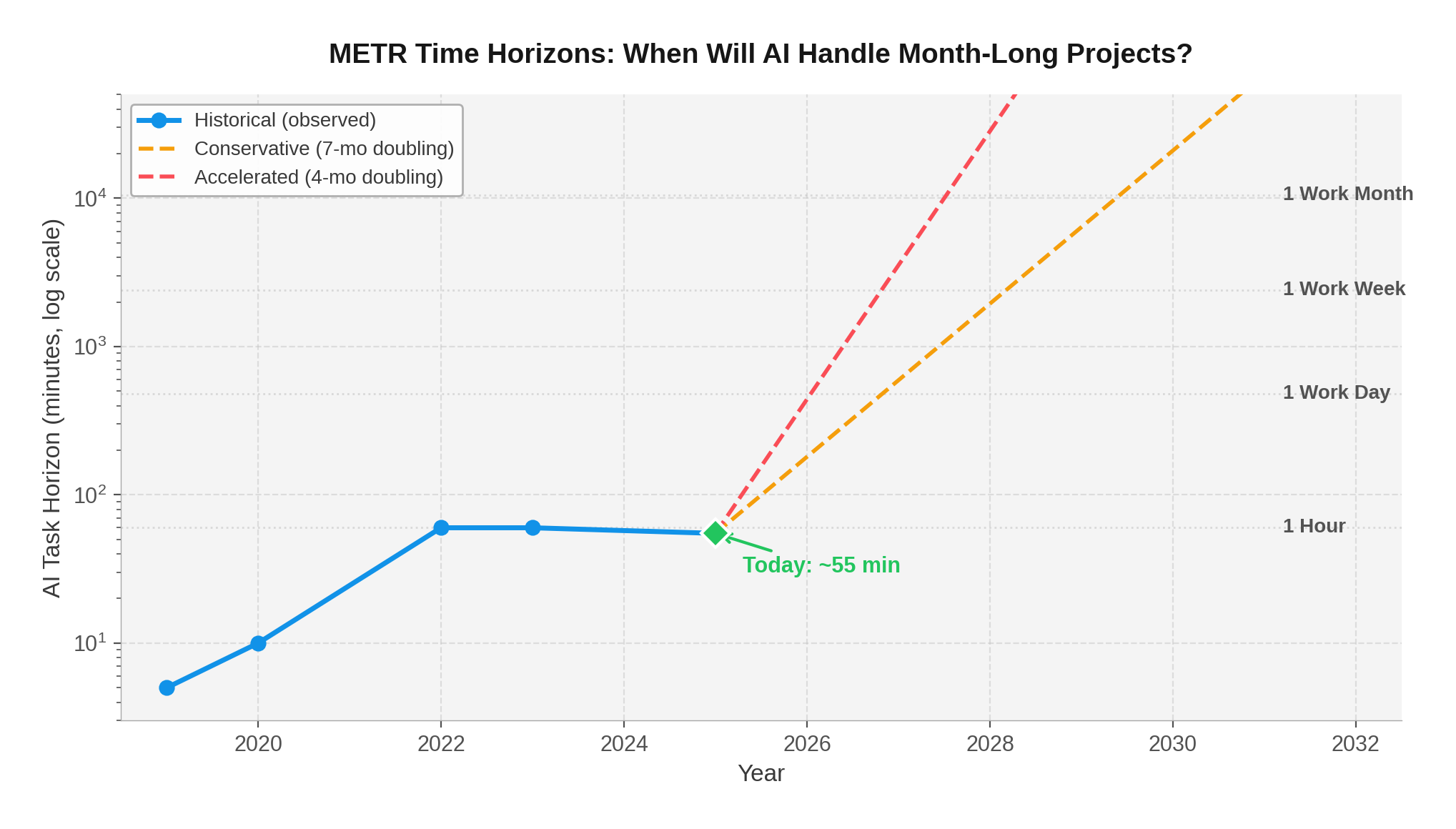
METR's time horizon research provides the broadest perspective on where multi-agent capabilities are heading. The length of tasks that frontier AI can complete with 50% reliability has been doubling every 7 months for the past 6 years. Recent data shows this may be accelerating to every 4 months.
Today's top models reliably complete tasks taking a skilled human about 50-60 minutes. If the conservative 7-month doubling continues, AI systems will handle:
This is where multi-agent orchestration becomes essential, not optional. A 55-minute task can run in a single context window. A month-long project requires decomposition, parallel execution, state management, and coordination — exactly the capabilities that current multi-agent systems are struggling to deliver reliably.
The data points to a clear strategy for organizations investing in AI agent capabilities:
Every successful production system uses centralized coordination. The 17.2x error amplification of independent agents isn't a theoretical risk — it's a measured outcome. Use one strong orchestrator (Opus-class) directing focused workers (Sonnet-class).
Multi-agent systems use 3-15x more tokens than single agents. Plan for this in your cost models. The 90% performance improvement from Anthropic's architecture came with a 15x token cost — that's the real exchange rate.
Parallelizable tasks benefit from more agents. Sequential reasoning tasks do not. Google's framework correctly predicts the optimal coordination strategy for 87% of held-out configurations. If your task is inherently sequential, a single powerful agent will outperform a swarm.
Stop evaluating agents on SWE-Bench Verified (70% solved). Use SWE-EVO (21%), ACE-Bench (7.5%), or APEX-Agents (24%) to measure against the complexity your developers actually face.
79% of organizations lack agentic AI governance frameworks. The 40% project failure rate isn't a technology problem — it's a process problem. BCG's 10-20-70 rule is real: 70% of your effort should go to people and process, not the model.
Month-long autonomous projects are 2-5 years away. Start building the orchestration infrastructure, decomposition patterns, and supervision workflows now. The organizations that nail multi-agent coordination in 2026 will be the ones ready for full autonomy in 2030.
The Winning Formula
Orchestrator-worker pattern + task-appropriate decomposition + human supervision + realistic benchmarking. This combination consistently delivers results across Anthropic, Verdent, IBM, and every other system that's proven itself in production. The swarm dream isn't dead — it just requires more structure than anyone expected.
Published February 5, 2026 · Analysis by aictrl.dev