2026-04-22

The Great Convergence: How Chinese AI Models Caught the West in 18 Months

DeepSeek trained a frontier model for $5.6M. OpenAI's GPT-5.5 just retook the closed-model lead on Artificial Analysis. Kimi K2.6 still holds the #1 spot on SWE-bench Verified. Alibaba's Qwen overtook Meta's Llama in global downloads.

$5.6M
DeepSeek V3 training cost (vs $100M+ for GPT-4)
80.2%
Kimi K2.6: #1 on SWE-bench Verified (Apr 2026)
3 pts
GPT-5.5 lead on Artificial Analysis Intelligence Index (Apr 23)
$1.7 vs $10
Kimi K2.6 vs Opus 4.7 cost per million tokens
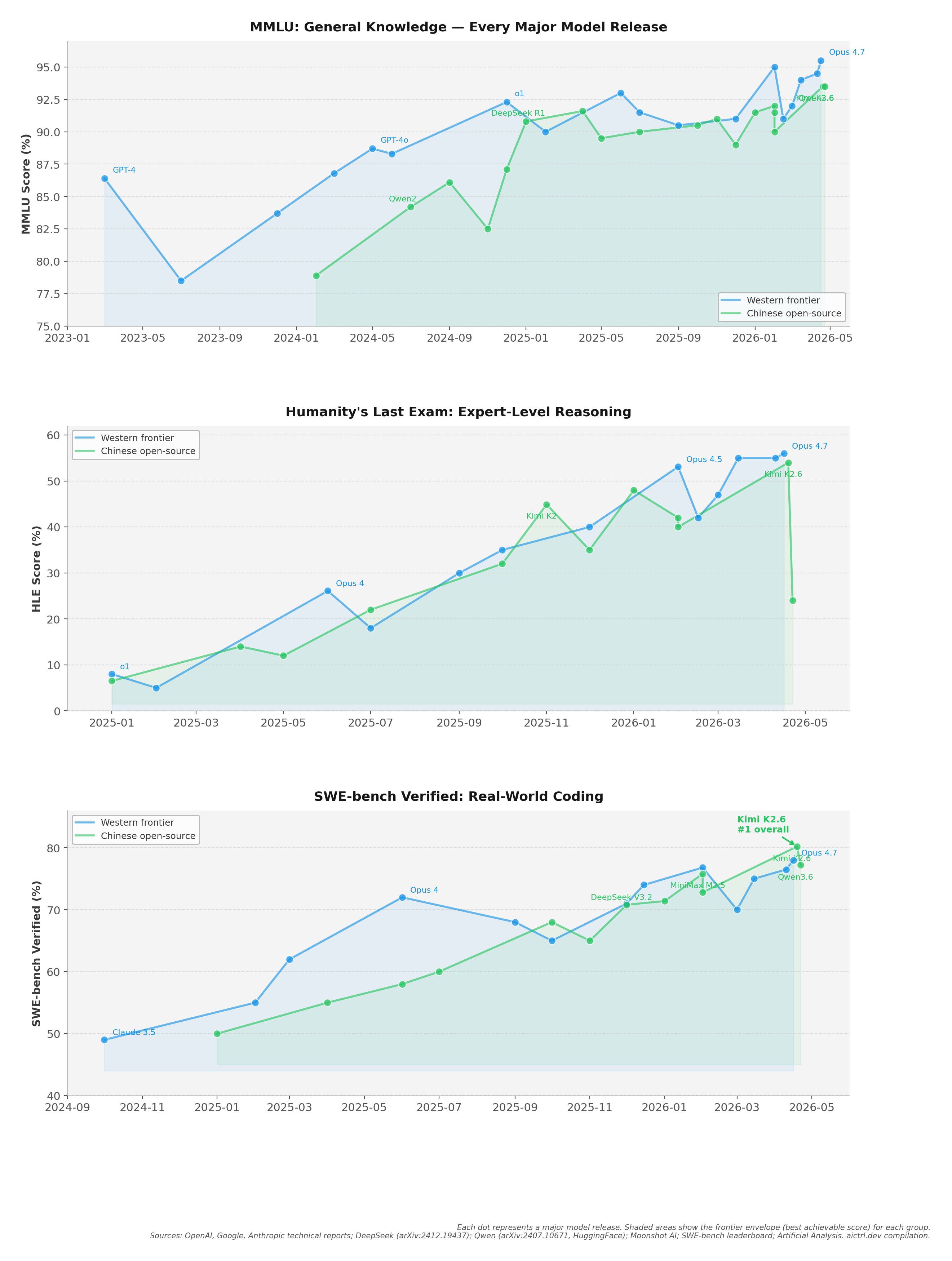
Timeline showing Chinese open-source models converging with Western frontier models across MMLU, HLE, and SWE-bench benchmarks
The Convergence in Three Benchmarks. MMLU (general knowledge), Humanity's Last Exam (expert reasoning), and SWE-bench Verified (real-world coding). Chinese open-source models (green) have closed the gap with Western frontier models (blue) — and on SWE-bench, Kimi K2.6 has overtaken them all. The shaded area shows the narrowing performance gap.

The DeepSeek Shock

On January 20, 2025, a relatively unknown Chinese hedge fund's AI lab released DeepSeek-R1 — a reasoning model that matched OpenAI's o1 on math, code, and logic benchmarks. It was trained with pure reinforcement learning, without any human-labeled reasoning traces. And it was released under an MIT license.

One week later, Nvidia lost $589 billion in market capitalization in a single trading session — the largest one-day loss for any company in US stock market history. The trigger wasn't just that DeepSeek matched frontier performance. It was the price tag.

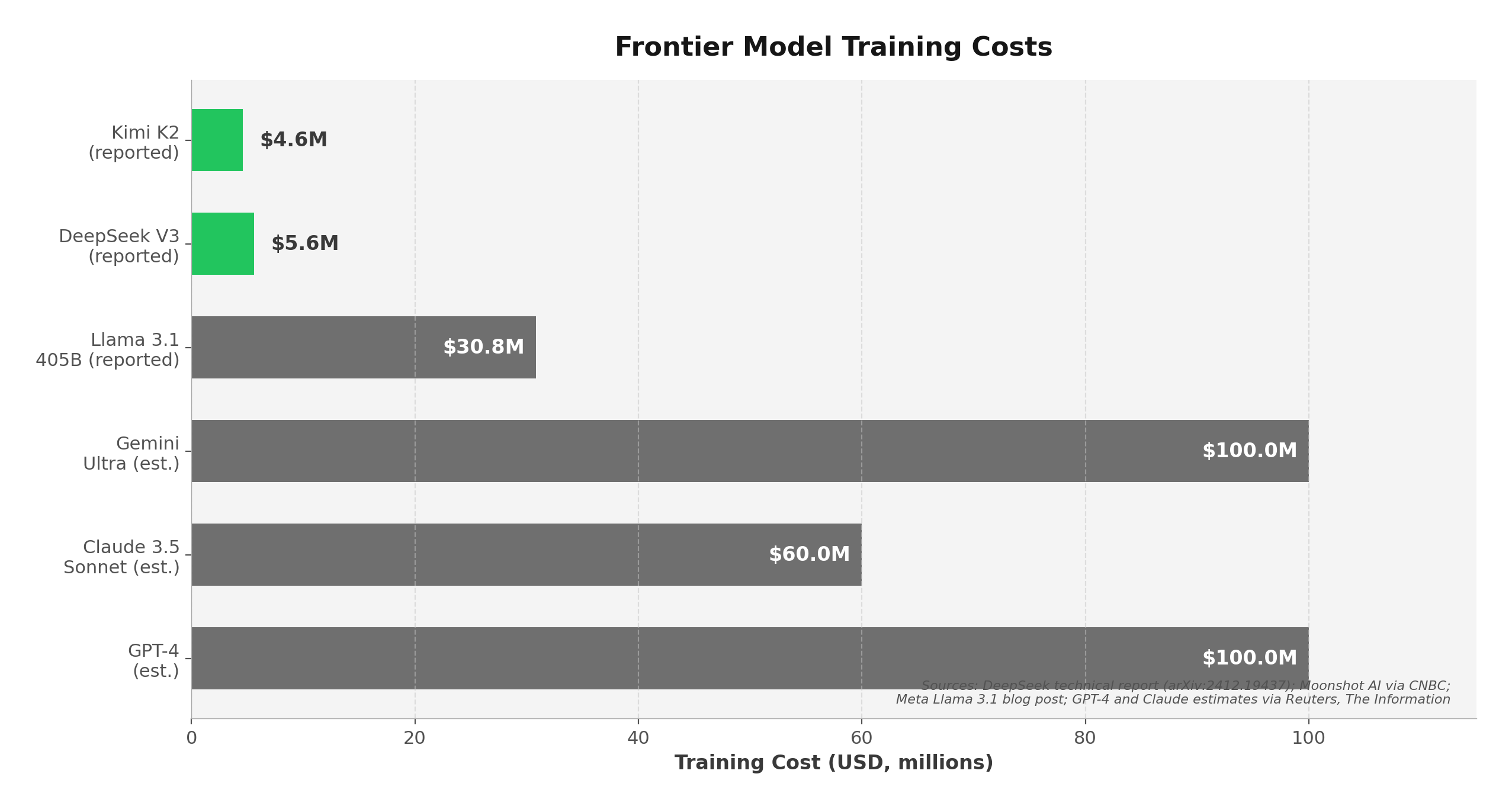
Training cost comparison between Chinese and Western frontier models
Figure 1: Frontier model training costs. DeepSeek V3 reported 2.788M H800 GPU hours for $5.6M. Meta's Llama 3.1 405B required 11x more compute. GPT-4 and Claude costs are estimates from industry sources.

DeepSeek-V3, the base model behind R1, is a 671 billion parameter Mixture-of-Experts model that activates only 37B parameters per token. It was trained on 14.8 trillion tokens using just 2,788,000 H800 GPU hours — chips that are the previous-generation Nvidia hardware subject to US export controls. Andrej Karpathy noted: "DeepSeek-V3 looks to be a stronger model at only 2.8M GPU-hours (~11X less compute)" than Meta's Llama 3.1 405B.

"DeepSeek R1 is AI's Sputnik moment."

— Marc Andreessen, January 26, 2025

The comparison to Sputnik was apt. Just as the Soviet satellite launch in 1957 shattered American assumptions about technological supremacy, DeepSeek shattered the assumption that frontier AI required billions in compute investment. And it came from a lab that most people in Silicon Valley had never heard of.

President Trump called it a "wake-up call" for US industry. Sam Altman conceded it was "invigorating to have a new competitor." Dario Amodei published a detailed essay acknowledging that DeepSeek "shows why China is a serious competitor to the U.S."


The Benchmark Convergence

The DeepSeek shock wasn't a one-off. Over the following 14 months, Chinese labs consistently matched or approached Western frontier performance across every major benchmark.

By April 2026, the race had tightened to a dead heat. Claude Opus 4.7, Gemini 3.1 Pro, and GPT-5.4 were tied at the top of the Artificial Analysis Intelligence Index. Then, on April 23, 2026, OpenAI released GPT-5.5, and Artificial Analysis moved OpenAI back into the outright lead by 3 points. That update doesn't erase the convergence story. Kimi K2.6 at 54 remains the strongest open-weights model, still close enough to keep intense price pressure on every closed-model vendor.

On the SWE-bench Verified leaderboard — the de facto standard for real-world coding ability — Chinese models didn't just compete. Kimi K2.6 scored 80.2%, taking the #1 spot overall. Qwen3.6-27B hit 77.2% from a 27B dense model that runs locally on a laptop. Four of the top ten models were from Chinese labs. OpenAI's newest published coding result is GPT-5.5 at 58.6% on SWE-Bench Pro, according to its April 23 launch post, but that is a different benchmark than the SWE-bench Verified chart used here.
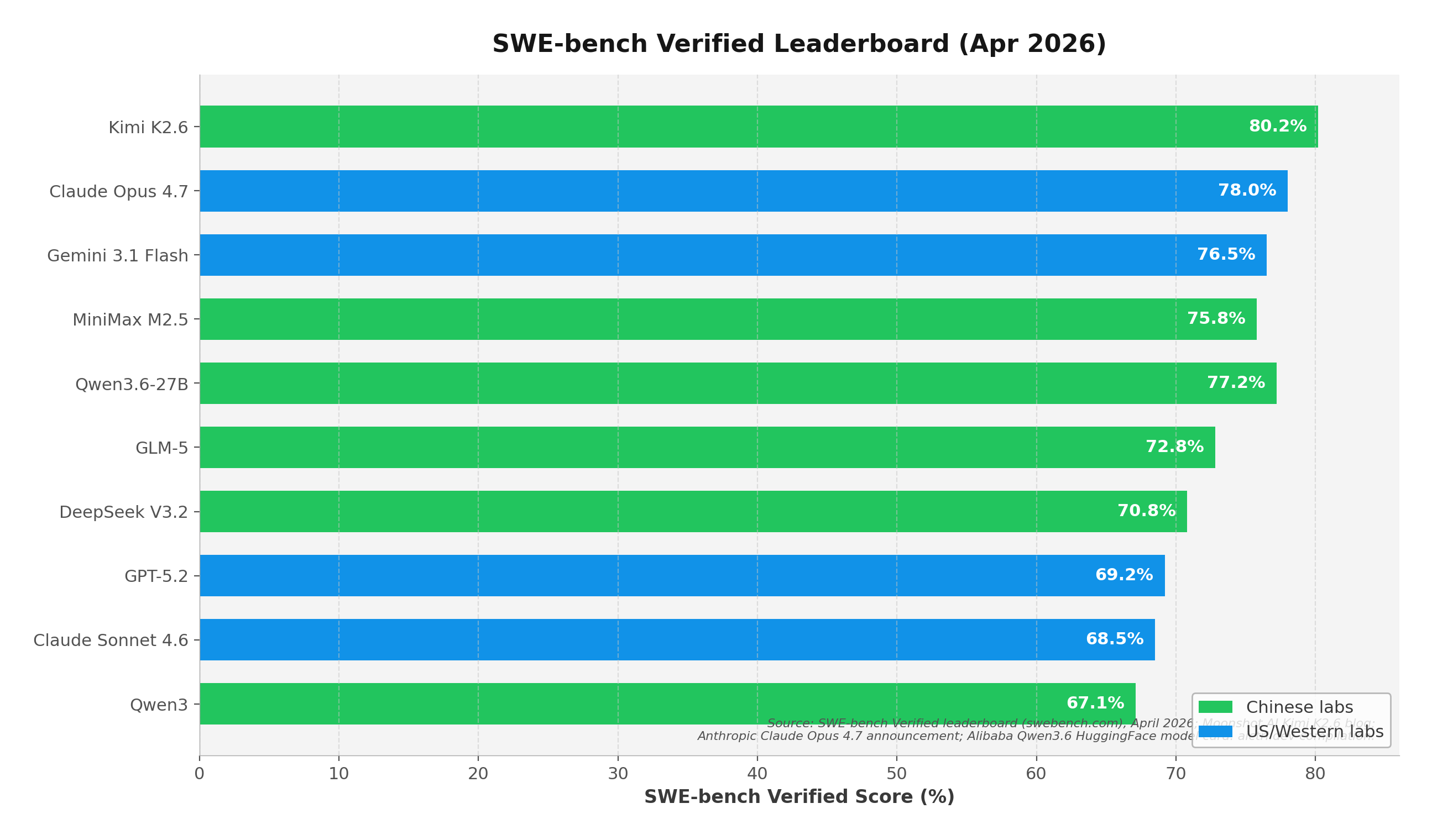
SWE-bench Verified leaderboard showing Chinese labs among top 10
Figure 2: SWE-bench Verified scores (Apr 2026). Kimi K2.6 takes the #1 spot at 80.2%. Qwen3.6-27B scores 77.2% from a 27B model that runs locally. Chinese labs hold 4 of the top 10 positions.

In reasoning, DeepSeek-R1 scored 79.8% on AIME 2024 (American Invitational Mathematics Examination), narrowly beating OpenAI o1's 79.2%. On MATH-500, it hit 97.3%. The model's "aha moment" — where it spontaneously developed self-verification and reflection during pure RL training — was published in Nature in September 2025 with 387k accesses and 623 citations.

In efficiency, Qwen2.5-72B outperformed Llama-3-405B despite being five times smaller. On MATH, it scored 83.1 vs 73.8. On LiveCodeBench, 55.5 vs 41.6. On Arena-Hard, 81.2 vs 69.3. Alibaba proved you didn't need the biggest model — you needed the best architecture.

The Efficiency Gap

Chinese labs consistently achieve comparable or superior results with fewer parameters. Qwen3.6-27B (55.6GB, Apache 2.0) now scores 77.2% on SWE-bench Verified — surpassing the previous-generation Qwen3.5-397B (807GB) at 14x smaller. It runs locally at 25 tokens/sec on consumer hardware. Kimi K2.6 (1T total, 32B active MoE) takes the overall #1 coding spot. This isn't just catching up — it's rewriting the cost-performance equation.
The Cost Revolution

The benchmark convergence matters because of what it means for pricing. Chinese models aren't just as good — they're dramatically cheaper.

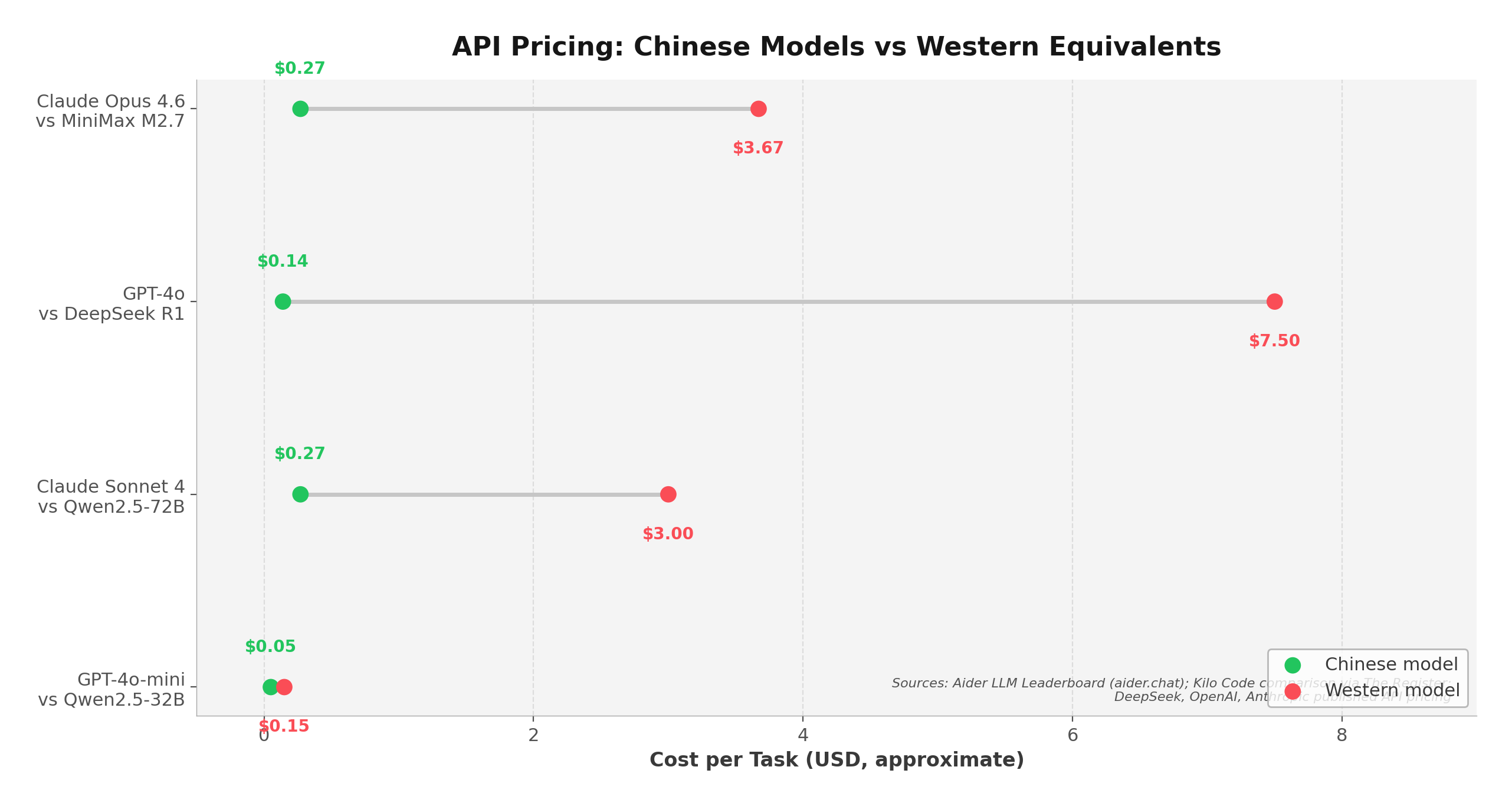
DeepSeek's API costs $0.14 per million tokens versus ChatGPT's $7.50 — a 53x price advantage. DeepSeek's subscription costs $0.50/month versus ChatGPT's $20. The company published a cost analysis showing it could theoretically achieve 545% profit margins at these prices, with GPU costs of just $87K/day against $562K potential daily revenue.

API pricing comparison between Chinese and Western models
Figure 3: Cost per task for comparable AI model APIs. Chinese models consistently deliver equivalent quality at 7-50x lower cost. MiniMax M2.7 delivers "90% of Claude Opus quality at 7% of the cost" (Kilo Code via The Register).

A RAND report published in early 2026 found that Chinese AI models run at roughly one-sixth to one-quarter the cost of comparable American systems. The cost advantage is structural, driven by algorithmic efficiency (MoE architectures, multi-head latent attention), government-subsidized electricity, and open-source feedback loops.

The Aider coding benchmark crystallizes the dynamic. DeepSeek V3.2 Reasoner scores 74.2% at $1.30 per benchmark run, while Claude Opus 4 scores 72.0% at $65.75. Same quality. Fifty times cheaper.

"US AI firms face rivals who deliver similar results for one tenth of the price or less."

— The Register, March 2026

The pricing pressure has cascaded through the market. DeepSeek's pricing forced ByteDance, Alibaba, and others to cut their own model prices or offer free tiers. MiniMax adopted Anthropic's API format for compatibility. The market is converging on Chinese pricing, not Western.


Open-Source Dominance

Perhaps the most consequential shift isn't in pricing or benchmarks — it's in the open-source ecosystem. Chinese labs haven't just matched Western performance; they've captured the developer mindshare that comes with open-weights releases.

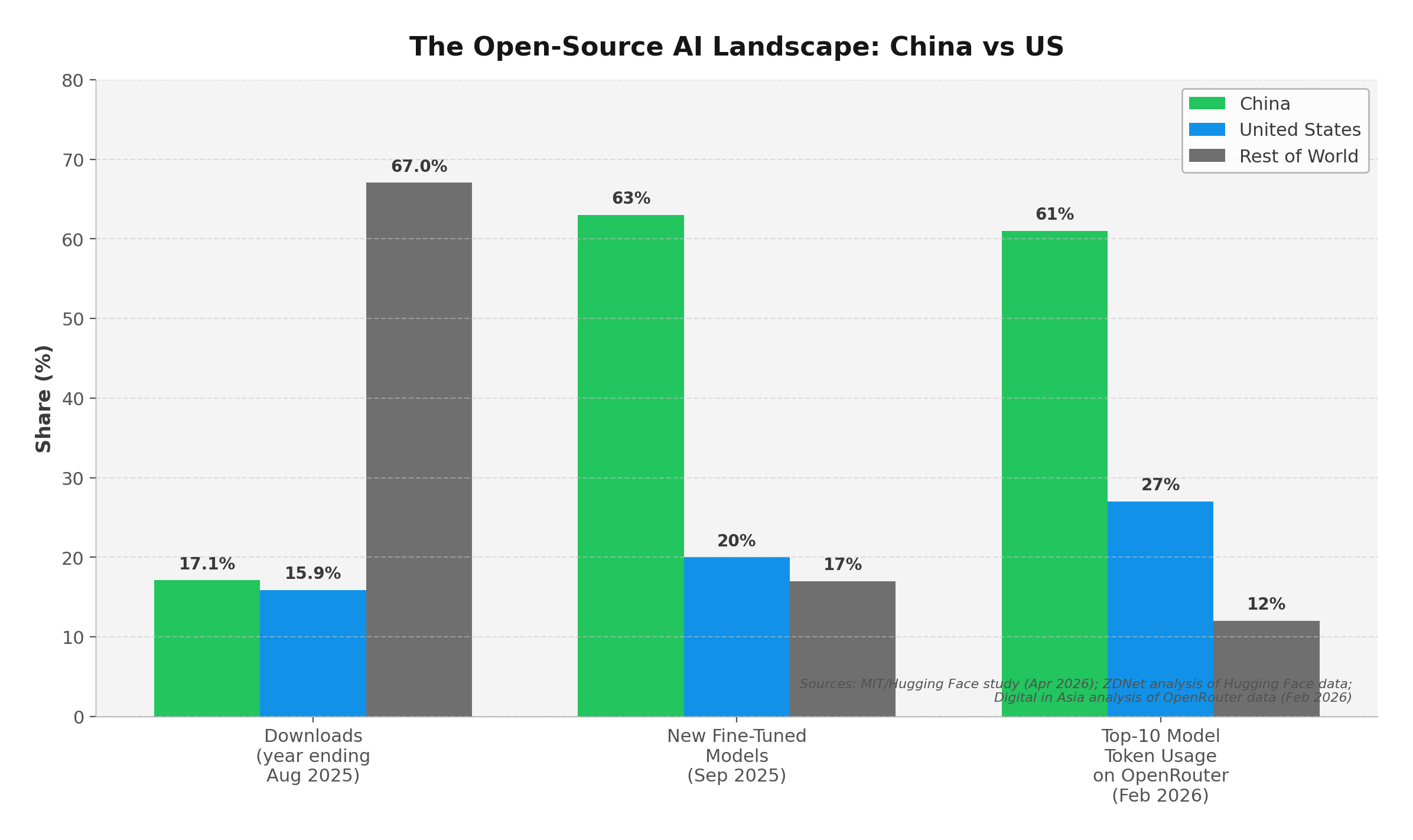
An MIT and Hugging Face study published in April 2026 found that Chinese open-weight models accounted for 17.1% of global AI model downloads for the year ending August 2025, surpassing the US share of 15.86%. It was the first time China led this metric.

Open-source AI landscape showing China vs US adoption
Figure 4: Chinese open-source models now lead in downloads, derivative models on Hugging Face, and token consumption on OpenRouter. Alibaba's Qwen has the most user-generated variants globally — more than Google and Meta combined.

By September 2025, 63% of all new fine-tuned models on Hugging Face were built on Chinese base models, according to ZDNet analysis. Alibaba's Qwen models alone have over 100,000 derivatives — the largest model ecosystem on Hugging Face. Qwen overtook Meta's Llama as the foundation of choice for the global developer community.

On OpenRouter, the AI model routing platform, Chinese models accounted for 61% of token consumption among the top ten models in February 2026. Four of the top five most-used models globally were Chinese. The top six models on OpenRouter's popularity rankings are now all Chinese: MiMo-V2-Pro, Step 3.5 Flash, DeepSeek V3.2, MiniMax M2.7, MiniMax M2.5, and GLM 5 Turbo.

Enterprise Adoption Signal

This isn't just developer experimentation. Cursor AI — one of the most popular AI coding tools, valued at $2.6B — built their new Composer 2 feature on top of Moonshot's Kimi K2.5. Airbnb uses Qwen for customer service chatbots due to comparable capability at lower cost. Singapore's OCBC bank runs 30+ internal tools on DeepSeek and Qwen. The dual-stack strategy — US infrastructure layered with Chinese open-source models — is becoming standard in Southeast Asia.

AI researcher Nathan Lambert observed: "At the start of 2025, most people loosely following AI probably knew of 0 Chinese AI labs. Now... DeepSeek, Qwen, and Kimi are becoming household names." He estimates the raw performance gap between Chinese open models and Western closed models at 4-6 months — but Chinese labs release faster, creating a practical availability advantage.


How They Did It: Innovation Under Constraints

The obvious question: how did Chinese labs achieve parity with a fraction of the compute? The answer is a combination of algorithmic innovation forced by hardware constraints, architectural efficiency, and state-directed industrial policy.

Architectural Innovation

US export controls restricted access to Nvidia's most advanced chips (H100, H200). Chinese labs responded with algorithmic breakthroughs that squeezed more capability from less hardware:

Innovation Lab Impact
Multi-head Latent Attention (MLA)DeepSeekDramatically reduces KV cache memory
Auxiliary-loss-free MoEDeepSeekBetter load balancing without degrading model quality
GRPO (Group Relative Policy Optimization)DeepSeekPure RL training without human demonstrations
Hybrid Linear Attention + Sparse MoEQwen/Alibaba397B model with only 17B active per pass
Native INT4 QuantizationMoonshot1T params running on consumer hardware
DeepSeek Sparse AttentionDeepSeekCuts long-context API costs by half

The Domestic Chip Transition

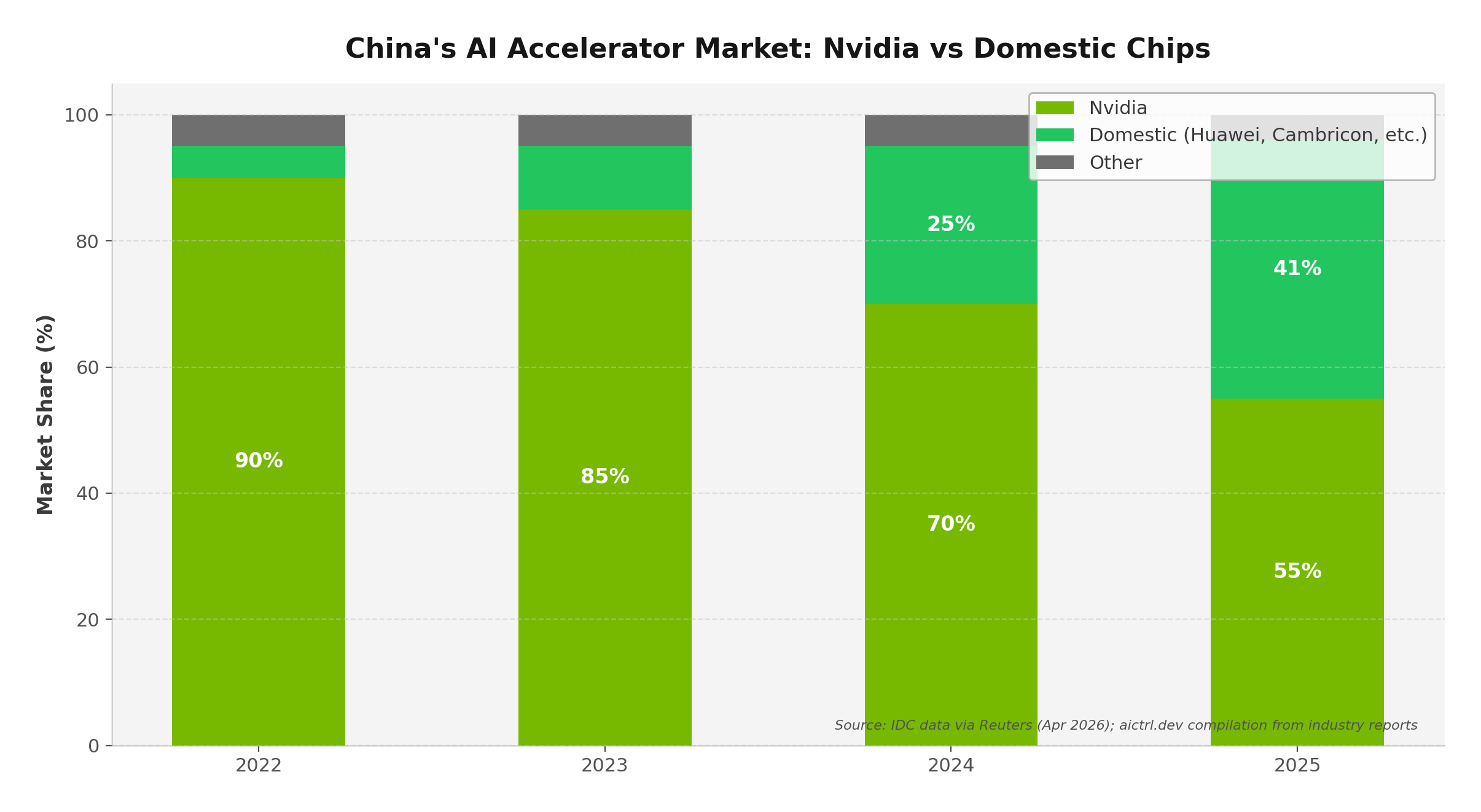
US export controls were supposed to strangle Chinese AI development. Instead, they catalyzed domestic chip production. IDC data shows Chinese GPU/AI chipmakers captured 41% of China's AI accelerator market in 2025, up from near-zero before export controls.

China AI chip market share: Nvidia vs domestic
Figure 5: China's AI accelerator market share by origin. Nvidia's dominance has eroded from 90%+ to 55% in three years. Huawei led domestic vendors with ~812,000 chips shipped in 2025. Source: IDC via Reuters (April 2026).

Huawei's Ascend 950PR chip, priced at ~$6,900 per card, has gained acceptance from ByteDance and Alibaba. Huawei plans to ship 750,000 units in 2026. Perhaps most telling: Nvidia's H200 chips approved for China in January 2026 have not been sold because the Chinese government is blocking purchases to redirect demand toward domestic alternatives.

The Dual Blockade

Commerce Secretary Lutnick confirmed in April 2026 that China isn't just being restricted from buying US chips — Beijing is deliberately refusing to buy approved Nvidia chips to accelerate domestic chip adoption. The US restricts supply; China restricts demand. The result: an indigenous chip industry is emerging faster than anyone predicted.

State-Scale Coordination

China's 15th Five-Year Plan (2026-2030) targets AI-related industries exceeding 10 trillion yuan ($1.4 trillion) by 2030. The "AI+" initiative mandates 70% sectoral AI penetration by 2027 and 90% by 2030. A $138 billion national venture capital fund targets robotics and high-tech industries. The Brookings Institution describes China as running "multiple AI races simultaneously" while the US focuses narrowly on AGI.


The Distillation Wars

The convergence has an ugly underbelly. In February 2026, Anthropic accused three Chinese AI labs — DeepSeek, Moonshot AI, and MiniMax — of operating over 24,000 fake Claude accounts to extract capabilities via distillation. MiniMax alone generated 13 million exchanges, Moonshot 3.4 million, and DeepSeek 150,000.

In response, OpenAI, Anthropic, and Google announced a joint effort through the Frontier Model Forum to combat adversarial distillation. A $1 billion AI Frontier Fund was announced in April 2026 to combat unauthorized model replication. OpenAI lobbied the Trump administration to ban "PRC-produced" AI models, calling DeepSeek "state-controlled."

But the political response collides with market reality. Microsoft, Perplexity, and Amazon all host DeepSeek models on their infrastructure. An estimated 80% of US startups use Chinese base models for derivative development, according to Digital in Asia analysis. The genie isn't going back in the bottle.


What Changed for Architecture Decisions

For CTOs, the important shift isn't that one Chinese lab beat one Western lab on one benchmark. It's that model strategy can no longer be centralized around a single frontier vendor. Performance has converged enough, and pricing has diverged enough, that the architecture question is now: which model class belongs to which workload?

The Strategic Shift

The scarce asset is no longer access to one "best" model. It is the evaluation, routing, and governance layer that lets your organization swap models by workload, prove quality before rollout, and contain risk when policy or vendor conditions change.

That has four implications for engineering leadership. First, a single-vendor AI stack is now a cost liability for many internal use cases. Second, open-weight models are now credible for tier-2 workloads such as internal coding assistance, analytics, and back-office automation. Third, benchmark literacy matters more than leaderboard watching: broad capability, coding agents, long-context reasoning, and operational reliability are different buying criteria. Fourth, security review and routing policy become first-class architecture concerns, not legal cleanup after procurement.

How To Read the Signal

Artificial Analysis tells you who is broadly strongest across a basket of tasks. SWE-bench tells you who is best at repository issue resolution. Aider measures iterative coding economics. Download share and token share tell you where developer ecosystems are forming. A serious buyer should not collapse those into one notion of "best model."

Workload Primary Decision Variable Recommended Model Class Why Red Flags
Internal coding copilotsCost per resolved taskChinese open-weight shortlist + frontier fallbackBest place to exploit cost/perf gains quicklyWeak eval harness, code exfiltration risk
Customer support automationQuality under policy constraintsDual-stack with strict routingHigh volume, measurable ROI, easy A/B testingHallucinations, data handling, escalation failures
Analytics and reportingToken economics + controllabilityOpen-weight firstLarge cost savings on repetitive internal workSpreadsheet/data quality drift, silent errors
Regulated workflowsGovernance and indemnityWestern frontier defaultSupport, contracts, and policy posture matter more than raw priceData residency, audit gaps, unclear provenance
Agentic back-office automationReliability over long horizonsBest-in-class by eval, not ideologyRouting quality matters more than brand loyaltyTool misuse, incident rollback, weak observability

What This Means for Enterprise Leaders

The competitive landscape has shifted from vendor comparison to portfolio design. Here's what enterprise technology leaders should do in the next two quarters:

1. Split Your AI Stack by Workload Tier

Stop asking which model your company should standardize on. Ask which model class belongs to which job. Tier 1: regulated, customer-facing, or revenue-critical workflows where support, indemnity, and incident handling matter most. Tier 2: high-volume internal workflows where cost and speed dominate. Tier 3: experimental or offline workloads where open-weight flexibility is worth the extra operational burden.

2. Run Structured Bake-Offs, Not Demo Comparisons

Use real tasks from your own engineering and operations backlog: bug-fix issues, support summaries, SQL analysis, runbook generation, and policy-constrained agent flows. Measure task success rate, retry rate, latency, token cost, and human correction time. The winning model is the one with the best cost per acceptable outcome, not the prettiest benchmark screenshot.

3. Build the Routing and Governance Layer First

Your durable advantage will not be vendor access. It will be a platform layer that can route prompts by workload, region, sensitivity, and policy. Require model allowlists, audit logs, eval gates, rollback controls, prompt and output retention policy, and provenance tracking before large-scale rollout. This is the difference between optionality and unmanaged sprawl.

4. Start Where the ROI Is Highest and the Blast Radius Is Lowest

The first production candidates are usually internal coding assistants, analytics copilots, document processing, and back-office support flows. Those workloads have clear economics and manageable risk. Leave heavily regulated decisions, sensitive customer data, and externally exposed autonomous agents on the most supportable stack until your governance model is proven.

5. Be Explicit About Where Western Models Still Win

Chinese models are forcing a repricing of the market, but Western frontier vendors still tend to offer the stronger enterprise support model, contractual posture, and governance maturity. For some teams, that is worth the premium. The right conclusion is not "replace everything." It is treat closed frontier models as premium infrastructure and deploy them where trust, support, and compliance outweigh raw token economics.

A Practical 90-Day Plan

Days 1-30: shortlist workloads and run sandbox evaluations. Days 31-60: add red-team tests for prompt injection, data leakage, and incident rollback. Days 61-90: deploy a dual-stack pilot with explicit routing rules, weekly quality reviews, and kill switches. The goal is not ideological alignment. It is to learn where cheaper models are good enough and where premium models still earn their keep.

Disclosure: aictrl.dev builds skills governance and workflow orchestration tooling for engineering teams deploying AI in production. We help teams evaluate, test, and deploy AI capabilities with provable quality gates — regardless of which model provider you choose. If your team is navigating the convergence of Chinese and Western AI models, see how aictrl.dev can help.


Sources

Published April 22, 2026 · Updated April 23, 2026 · Analysis by Bulat at aictrl.dev

AI-assisted research and editing. Final analysis reviewed by Bulat.

Bulat Yapparov
Bulat Yapparov
Founder at aictrl.dev

Former Director of Data Engineering at HeliosX, where he built the Data Platform at scale using AI. Now building aictrl.dev — the observability and governance layer for enterprise AI agents.